
Compliance Program Build-Out
Infrastructure-verified compliance program achieving SOC 2 readiness, with systematic control mapping across three frameworks, 35 security remediation tickets driving engineering action, and a streamlined policy framework designed for long-term maintainability
3 compliance frameworks
35 remediation tickets

The Problem
GovTech SaaS company serving 500+ government clients needed to build, verify, and maintain a multi-framework compliance program across SOC 2, ISO 27001:2022, and NIST AI RMF - with no dedicated compliance team and policies containing unverified infrastructure claims
A GovTech SaaS company providing digital twin and infrastructure management technology to over 500 government clients had established an initial policy framework across 25+ security policies managed through a GRC platform. As the organization matured and its technology stack evolved, the gap between documented policies and operational reality had grown - creating latent audit risk that no one had systematically verified. Policies stated specific AWS configurations that had never been validated against production: the Backup Policy claimed cross-region replication that did not exist, multiple policies referenced NIST SP 800-88 Rev. 1 - a withdrawn federal standard - and key policies contained duplicated content making maintenance impractical. No policies addressed AI/ML data retention, HR data schedules, or the 12+ NIST AI RMF controls required for the company's pattern recognition, data validation, and LLM capabilities. A security assessment revealed operational gaps including unrestricted security group access, failing VPC flow logs, and overly permissive IAM policies. All of this needed to be resolved without a dedicated compliance team - by a fractional consultant coordinating across engineering, HR, IT operations, and executive stakeholders.
Before touching any policy document, a comprehensive AWS security assessment mapped current infrastructure state against documented requirements. Findings were prioritized by severity and translated into 35 actionable tickets with clear ownership assignments, priority ratings, and SLA timelines. A systematic infrastructure verification methodology was then developed using AWS CLI commands to validate every policy claim: S3 encryption audits confirmed AES-256 across all production buckets, RDS verification checked encryption, KMS associations, and Multi-AZ deployment across 10 database instances, and replication testing definitively confirmed that no cross-region replication existed - directly contradicting the Backup Policy. TLS configuration testing confirmed A+ SSL Labs ratings with TLS 1.3 on production domains. This verification uncovered the critical false geographic redundancy claim that would have been an immediate audit finding.
With infrastructure reality documented, the policy renewal addressed 25+ policies with 5 requiring substantive updates. The Data Retention Policy underwent a major rewrite from V1.0 to V2.1 - streamlined from 6 to 4 pages by removing sections duplicating backup and asset management policies, while adding AI/ML data retention requirements aligned with NIST AI RMF and the EU AI Act, plus HR data schedules meeting FLSA, EEOC, and IRS requirements. The data sanitization standard was updated from withdrawn NIST SP 800-88 Rev. 1 to Rev. 2 with IEEE 2883:2022 as a supplementary standard. The Backup Policy was corrected to accurately document Multi-AZ deployment within a single region, replacing the false cross-region claim - with the change log noting verification via AWS CLI.
For multi-framework control mapping, SOC 2 controls were brought to all-green status with zero open findings. The NIST AI RMF alignment required 12+ entirely new controls and processes: Data Protection Impact Assessments, AI committee governance structures, fairness and bias evaluation procedures, opt-out mechanisms for automated decisions, environmental impact assessments, AI-specific risk tracking, and responsible AI training modules. All policy updates were coordinated across VP Engineering, CTO, HR, and IT Operations with targeted review assignments. A critical process decision determined which updates required staff re-acknowledgment versus silent publication - preventing unnecessary disruption while maintaining compliance. Of 35 remediation tickets, 20 were closed during the engagement with the remainder tracked with documented remediation timelines.
Compliance frameworks aligned
Remediation tickets created
Policy-practice gaps
Why it mattered
Operating need
Security, HR, IT, and engineering needed one defensible view of what policies claimed and what production infrastructure actually did.
What changed
AWS verification, remediation tickets, and mapped AI governance controls reduced policy-practice gaps without expanding policy volume.
A compliance program rebuilt as a defensible operating system
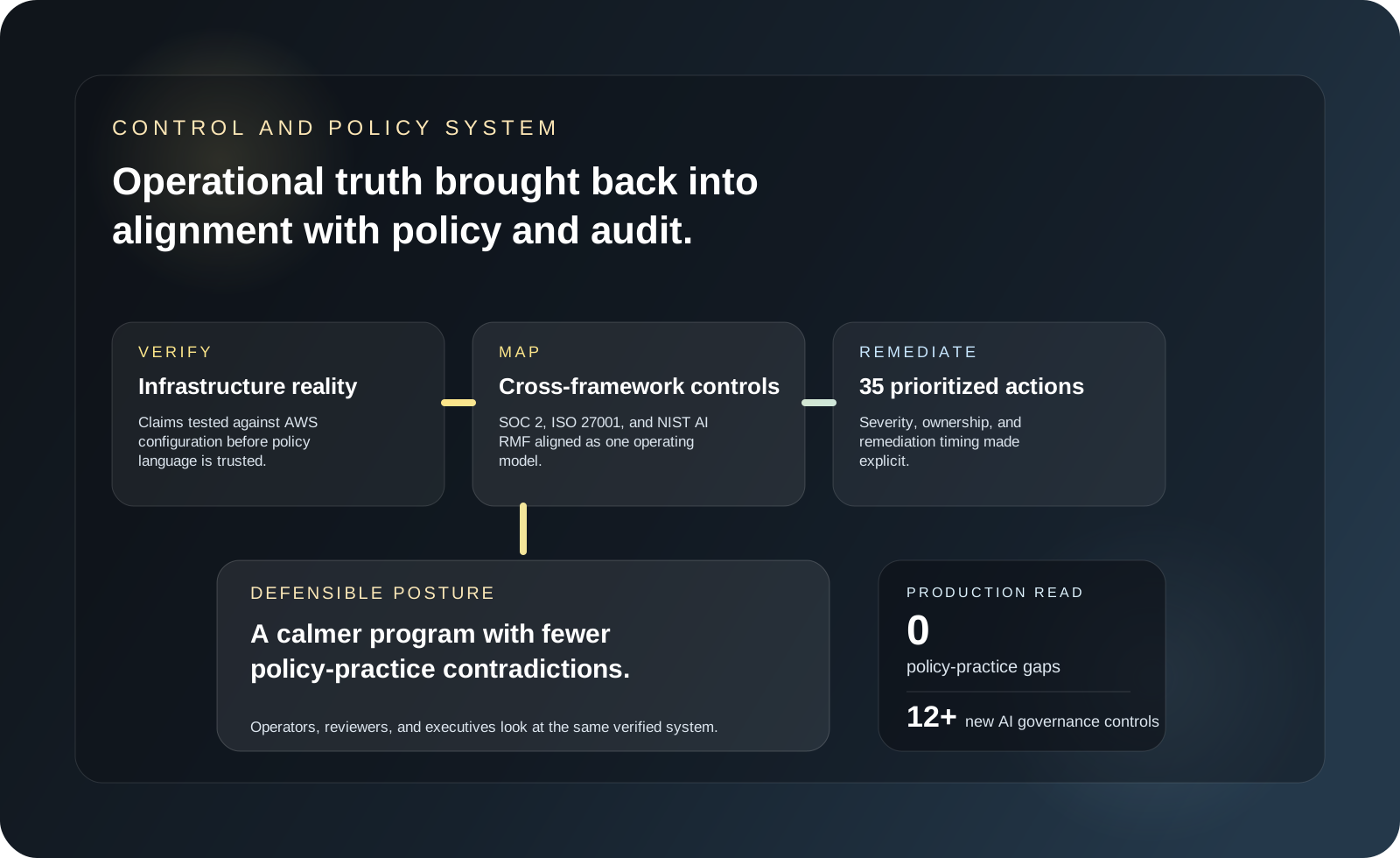
This engagement made infrastructure truth, remediation ownership, and cross-framework governance visible in the same operating model. The team could defend the program because the policy language matched verified production behavior.
Control frame
Infrastructure claims were verified against operational reality before policy language was allowed to stand.
AI controls
AI-specific controls were integrated into the wider operating model instead of isolated as a side initiative.
Audit posture
The result was a more legible compliance system with fewer gaps between what was documented and what actually existed.
Context
A GovTech SaaS company serving 500+ government clients needed multi-framework compliance (SOC 2, ISO 27001, NIST AI RMF) with no dedicated compliance team.
Constraint
Policies contained unverified infrastructure claims. No AI governance controls existed. Gap between documented policies and operational reality created audit risk.
Intervention
Ran infrastructure verification via AWS CLI, created 35 remediation tickets, rewrote 5 policies, and mapped 12+ new NIST AI RMF controls across all frameworks.
Outcome
SOC 2 all-green, 0 policy-practice gaps, 25+ policies reviewed, 12+ new AI governance controls, 20/35 remediation tickets closed during engagement.
Key Capabilities
Security Assessment & Remediation
Infrastructure Verification
Policy Framework Overhaul
Multi-Framework Control Mapping
Results
Planning a Similar Mandate?
A direct discovery call about the problem, the constraints, and the fastest credible path forward.
We respond within 4 hours during business hours