
Civic Infrastructure AI
Multi-pipeline AI platform: 197 asset types detected, 84K trees assessed, 99%+ crash extraction accuracy, 6,400+ automated tests
197 asset types
84K trees assessed

The Problem
Manual inspection of street-level imagery, tree hazards, road conditions, and crash reports at city scale, across millions of images and thousands of documents
Manual inspection of street-level imagery, tree hazards, road conditions, and crash reports at city scale. A major municipal government preparing for a global sporting event needed to catalog infrastructure assets, assess tree hazards, evaluate roadway conditions, and extract structured data from crash reports, all across an entire metropolitan area. Manual inspection could not scale. Street-level imagery existed but lacked automated analysis. 93,000+ street trees needed hazard scoring. 763 miles of roadway required condition assessment at 20-foot intervals. Thousands of crash reports across multiple jurisdictions sat as scanned PDFs and TIFFs with no structured data.
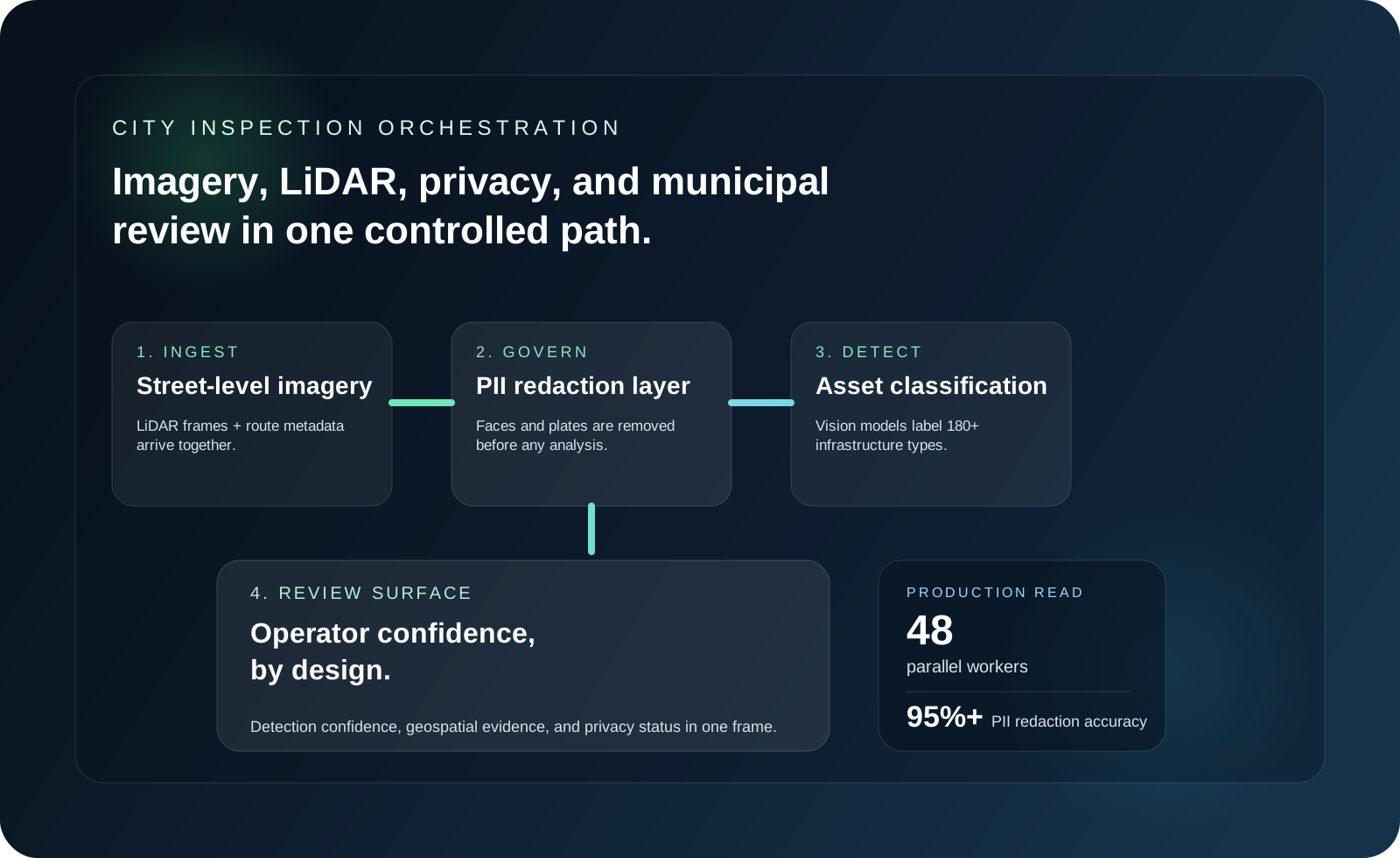
We built a multi-pipeline AI platform on AWS. The infrastructure detection pipeline uses Claude Sonnet and LiDAR point cloud processing to classify 197 asset types from street-level imagery, with position refinement, cross-collection deduplication, and interactive GeoJSON reports. The system runs on ECS Fargate with parallel workers and Bedrock Batch inference for 50% cost savings at scale.
A tree hazard assessment pipeline processed 86,164 street trees across 7 major event sites, achieving a 97.2% assessment rate. KD-tree bearing-based image selection finds the 15 best views per tree from 4.4 million camera records. A semantic retry mechanism improved 8,048 assessments from non-assessable to assessable, identifying 24 critical-priority and 3,085 high-priority trees. A separate roadway assessment pipeline extracts 12+ condition attributes from 205,707 survey points across 763 miles at 20-foot intervals.
A crash report extraction system handles multi-jurisdiction document processing with a hybrid OCR + LLM pipeline achieving 99.36–99.78% field accuracy. A crash narrative analyzer extracts 30 structured fields from narrative text across 13 jurisdictions with post-check validation rules. The full platform spans 6,400+ automated tests across Python and Rust codebases.
Trees assessed (97.2% rate)
Crash extraction accuracy
Automated tests
Why it mattered
Operating need
Municipal teams had to review assets, trees, roads, and crash records at city scale without losing audit visibility.
What changed
Five domain-specific pipelines produced evidence operators could inspect through maps, reports, downloads, and post-check validation.
A multi-domain AI platform built for municipal trust
The core problem was building five specialized AI pipelines that operators could verify: infrastructure, trees, roads, crash documents, and narratives. Each domain needed its own accuracy checks and review surface.
Domain coverage
Infrastructure assets, tree hazards, roadway conditions, crash reports, and narrative analysis. Each pipeline operates independently but shares a common compliance and delivery framework.
Risk control
Every pipeline is gated by domain-specific accuracy validation and post-check rules, backed by 6,400+ automated tests across Python and Rust, and managed with security-reviewed delivery practices.
Operator confidence
Interactive Leaflet maps, GeoJSON downloads, and drill-down reports were structured to support municipal review and audit visibility, not just raw model throughput.
Context
A major municipal government preparing for a global event needed to catalog 197 infrastructure asset types, assess 93K street trees for hazards, evaluate 763 miles of roadway, and extract structured data from thousands of multi-jurisdiction crash reports.
Constraint
Manual inspection could not scale. Each domain (infrastructure, trees, roads, crashes) required specialized AI pipelines with domain-specific accuracy validation.
Intervention
Built a multi-pipeline AI platform: infrastructure detection (Claude + LiDAR), tree hazard scoring (KD-tree image selection, semantic retry), roadway assessment (12+ attributes at 20ft intervals), and crash extraction (hybrid OCR + LLM, 99%+ accuracy).
Outcome
197 asset types detected, 84K trees assessed (97.2% rate, 24 critical found), 99.36–99.78% crash extraction accuracy, and 6,400+ tests.
Architecture
Multi-domain AI platform from imagery to structured intelligence
Vision Detection
Tree Hazard Assessment
Document Extraction
Data Platform
Tech Stack
Compute
AWS ECS Fargate + Bedrock Batch
AI Models
Claude Sonnet 4.6, Qwen 3 VL, Grounding DINO
Languages
Python + Rust (54K LOC Rust)
Data
Snowflake, S3, Textract OCR
Spatial
LiDAR point clouds, KD-tree indexing
Delivery controls
SOC 2-aligned practices
Results
Planning a Similar Mandate?
A direct discovery call about the problem, the constraints, and the fastest credible path forward.
We respond within 4 hours during business hours