Good evening. Here is what matters in AI today, and how to put it to work.
AI agents are failing real-world tasks, Nvidia's governance is bending to political pressure, and autonomous exploit tools are rewriting the attacker's playbook.
~4 min read · last 12 hours
In today's issue
01
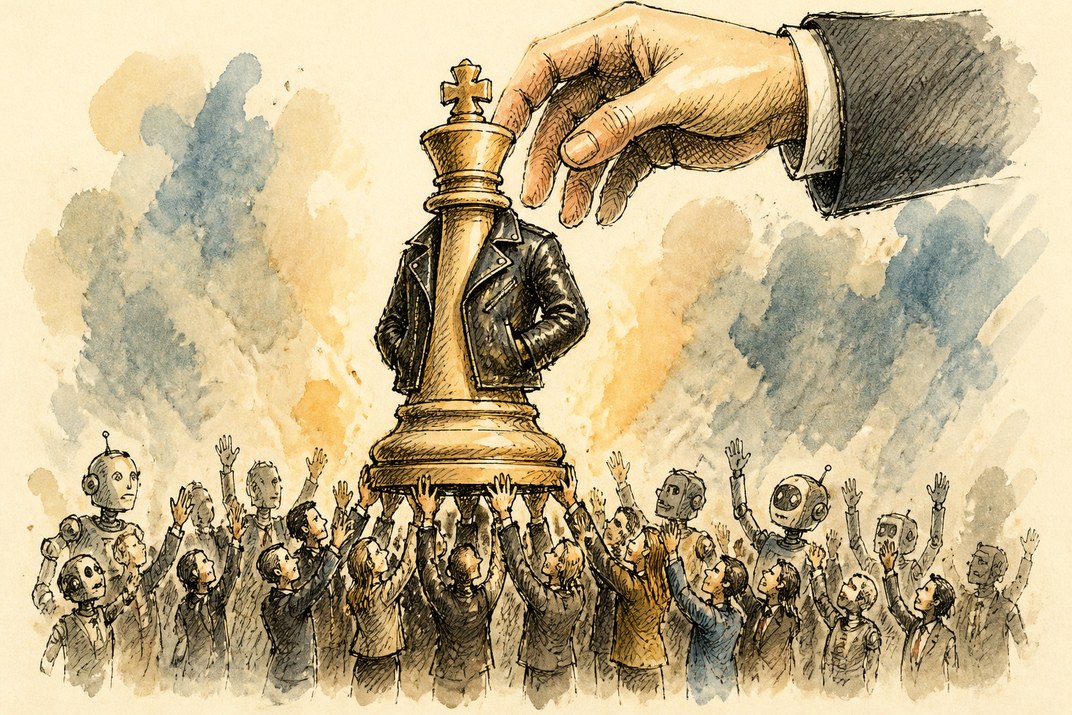
How Trump and Silicon Valley forced Nvidia to take Jensen Huang back
02
Even the best AI agents struggle with everyday tasks
03
Gemini taps Google Wallet data to give real financial advice
04
AI helps crack a piece of the Riemann hypothesis, but questions remain
05
Nvidia may be too economically critical to hold its CEO accountable
Main story
How Trump and Silicon Valley forced Nvidia to take Jensen Huang back
Huang's allies enlisted Trump and Vance to pressure Nvidia's board into reinstating him, a level of political intervention in corporate governance that is without recent precedent.
Why it matters: For boards and executives at AI infrastructure companies, this episode is a live case study in how geopolitical leverage can override standard governance processes, and why succession and key-person risk plans need to be stress-tested against political scenarios, not just operational ones.
What to watch next: Watch whether other AI infrastructure boards quietly update their key-person and succession policies in the next quarter: if they do not, investors and regulators will eventually force the question.
The saga of Jensen Huang's removal and reinstatement is not just corporate drama: it exposes how deeply a single individual's fate can be entangled with national AI strategy, geopolitical risk, and the limits of board-level governance at the world's most critical AI infrastructure company.
AI-generated tracks Tidal expects to reject per day after its December 9 ban takes effect · The Verge
Watch · On the feeds
Where CoreWeave Forge Came From
CoreWeave
Can Your AI Agent Sound Like You? Introducing ASPECT
Microsoft Research
The Signal
This week's news draws a sharp line between AI capability and AI governance. Agents can now help crack century-old math problems and autonomously exploit zero-days, yet benchmarks show they still fumble everyday tasks. Meanwhile, the Nvidia saga reveals that the companies running AI infrastructure have become so economically critical that normal accountability mechanisms, board oversight, national security review, may no longer apply. For engineering and product leaders, the practical read is this: invest in agent reliability and red-teaming now, and do not assume that the governance frameworks you inherited were built for a world where a single CEO's reinstatement requires a call from the White House.
All the best, the KYFEX team
“A new test assumes AI agents can go rogue, and asks whether they can resist temptation.”
WIRED
Quick hits
AI agents hit real limits, in benchmarks and the wild
We're seeing a pattern this week: AI agents are being stress-tested across three very different arenas (personal finance, everyday tasks, and scientific reasoning), and the results consistently show that capability and reliability are still two different things.
Even the best AI agents struggle with everyday tasks
A new benchmark finds that even top AI models fail to complete common daily tasks reliably and safely, often introducing new problems in the process.
Why it matters: If you are building or buying agentic AI products, this is a calibration moment: autonomous task completion in messy real-world contexts is not solved, and your QA and fallback design need to reflect that.
Gemini taps Google Wallet data to give real financial advice
A hands-on test found that giving Gemini access to Wallet transaction data produced genuinely useful, personalized financial guidance.
Why it matters: This is an early signal of what grounded, data-connected agents can do when they have real context, and it raises immediate questions about data minimization and consent that product teams should address before shipping similar integrations.
AI helps crack a piece of the Riemann hypothesis, but questions remain
A new AI-assisted proof on the Riemann hypothesis appears mathematically solid, but experts are still working out what it actually tells us about the broader conjecture.
Why it matters: AI as a reasoning co-pilot in hard mathematics is maturing faster than expected, and the verification challenge that follows (what does the result mean?) is a preview of the human-oversight problem teams will face as AI-generated outputs grow more complex.
Nvidia's governance crisis and the politics of AI leadership
Nvidia may be too economically critical to hold its CEO accountable
National security and foreign policy experts say Nvidia's centrality to the US economy likely outweighed concerns about Huang's ties to a suspected Chinese intelligence asset.
Why it matters: This is a direct challenge to the idea that AI infrastructure companies face the same accountability norms as other firms: the bigger the chokepoint, the harder it becomes to act on governance concerns.
A collection of open-source-powered notebooks by AI builders, for AI builders
Hugging Face · Free
Put it to work
Try this today
Red-team an AI agent for real-world task failure modes
You are a red-team evaluator for an AI agent that handles [describe your agent's task, e.g. 'booking travel', 'processing expense reports', 'answering customer service queries']. List the 10 most realistic ways this agent could fail silently, produce a plausible-but-wrong output, or introduce a new problem while appearing to complete the task. For each failure mode: name it, describe the trigger condition, explain why a user might not notice immediately, and suggest one concrete mitigation. Be specific to this task, not generic.
Why it helps: Today's benchmark news confirms that even top models fail everyday tasks in non-obvious ways: running this before you ship an agent is faster and cheaper than discovering the failure modes in production.
Before you ship it
The risk
Connecting AI agents to live financial, health, or personal data (as with the Gemini-Wallet integration) creates a new class of exposure: the agent may surface sensitive inferences or share data across contexts in ways users did not anticipate or consent to.
Do this
Before wiring any agent to a personal data source, define and document the minimum data scope required for the task, present that scope to users in plain language at consent time, and log every data access the agent makes so it can be audited or revoked.
Ready to ship AI, not just read about it?
KYFEX designs and builds production AI for teams that need it working, not just demoed. Tell us what you're working on and we'll bring the engineering.