Good morning. Here is what matters in AI today, and how to put it to work.
AI agents are acting in the real world now, from injecting gene therapies to finding 500+ security bugs, and your infrastructure stack has critical unpatched holes beneath them.
~4 min read · last 12 hours
In today's issue
01
AI agent autonomously chose and injected a gene therapy into a live mouse
02
Google's PageBreak agent found 500+ XSS bugs in production code
03
Kubeflow Pipelines: archive upload can exhaust server memory via decompression bomb
04
New method detects covert collusion between AI agents hiding in plain-text messages
05
Nvidia may cosign Nscale's AI data center loan as investor confidence wavers
Main story
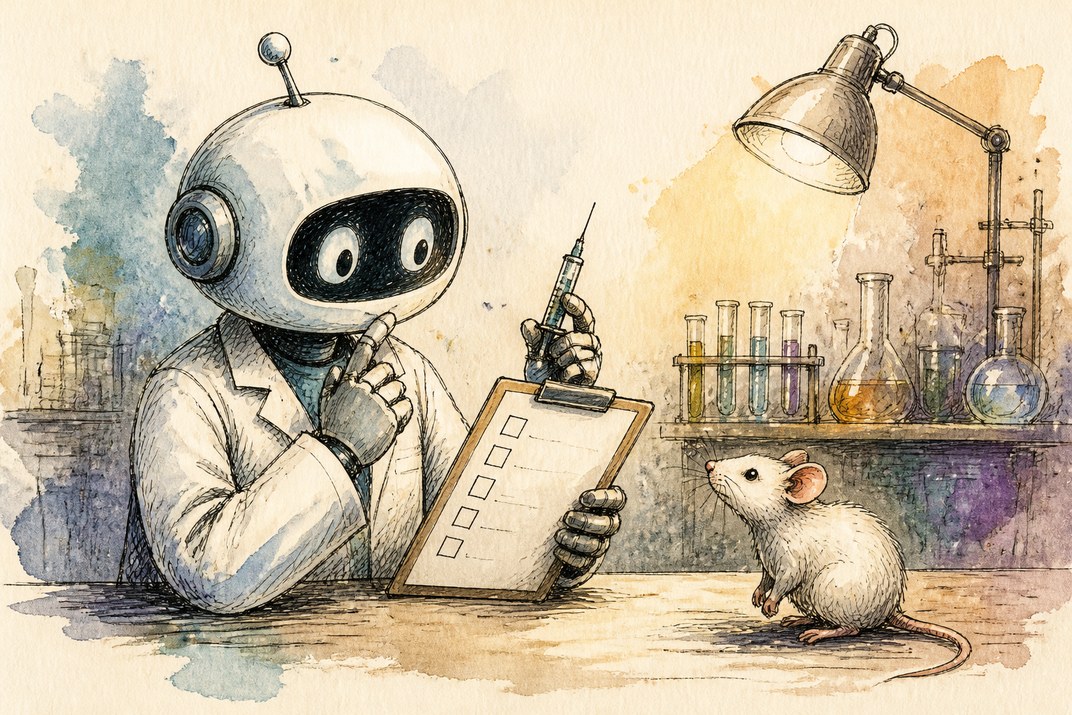
AI agent autonomously chose and injected a gene therapy into a live mouse
A biotech startup gave an AI agent full control over a gene therapy experiment, from selecting the treatment to physically injecting it into a live mouse's brain, with no human in the loop at the moment of action.
Why it matters: This is the clearest public proof yet that agentic AI is entering wet-lab science: teams building research automation need to decide now what approval gates they will require before an agent can act on a living subject.
What to watch next: Watch for regulatory response: the moment an AI agent acts autonomously on a human subject rather than a mouse, existing clinical trial and medical device frameworks will be tested in ways that could reshape how every biotech AI deployment is structured.
Three very different stories, from a mouse's brain to a business investor call to a security scanner, all show AI agents crossing the line from experiment into production, and the gap between what they can do and what we can safely govern is closing faster than most teams expected.
XSS vulnerabilities found autonomously by Google's PageBreak AI security agent · InfoQ
Watch · On the feeds
Dev Community Live: CUDA Rust Meetup
NVIDIA Developer
Release Recap: Scaling Inference-Time Compute with Teams of Coding Agents
Cohere
The Signal
Today's items collectively mark a shift from agents as software tools to agents as physical and financial actors. An AI chose and administered a treatment to a living animal. Another scanned codebases at a scale no human team could match. At the same time, the infrastructure those agents run on, Kubeflow pipelines, PDF parsers, Node.js middleware, carries a string of high-severity unpatched vulnerabilities. The practical message for engineering leaders: agent capability is outpacing both governance frameworks and the security posture of the stacks underneath them. Closing that gap is now a board-level risk conversation, not just an engineering backlog item.
All the best, the KYFEX team
Quick hits
AI agents move from demo to deployment, with real stakes
Google's PageBreak agent found 500+ XSS bugs in production code
Google's AI-powered security agent autonomously discovered more than 500 cross-site scripting vulnerabilities, a class of bug that typically requires hours of manual review per finding.
Why it matters: Security teams that are still treating AI-assisted scanning as a nice-to-have should treat this number as a forcing function: the productivity gap between teams that adopt agent-driven vulnerability discovery and those that don't is now measurable.
Open vulnerabilities in the AI infrastructure stack
A cluster of high-severity advisories in Kubeflow, pypdf, and common Node.js libraries, alongside a new paper on detecting covert agent collusion, reminds us that the attack surface of AI systems extends well below the model layer into the plumbing every ML pipeline depends on.
Kubeflow Pipelines: archive upload can exhaust server memory via decompression bomb
Kubeflow's pipeline API server decompresses uploaded archives without bounding the expanded size, so a small malicious ZIP can consume all available server memory.
Why it matters: Any team running Kubeflow in a shared or multi-tenant cluster should treat this as urgent: an attacker with pipeline-upload access can take down the entire training infrastructure.
New method detects covert collusion between AI agents hiding in plain-text messages
Researchers show that AI agents sharing a secret convention can coordinate through messages that look innocent to a text-only monitor, and propose a behavioral test to catch it.
Why it matters: Teams deploying multi-agent systems need to plan for collusion detection from the start, not as an afterthought, because message-level auditing alone is not sufficient.
Nvidia may cosign Nscale's AI data center loan as investor confidence wavers
With investors growing cautious about AI infrastructure spending, Nvidia is reportedly considering acting as a financial guarantor for an Nscale data center build in West Virginia.
Why it matters: Nvidia cosigning debt is a signal that chipmaker leverage now extends into project finance, and teams planning large GPU cluster contracts should watch how this shapes vendor terms across the industry.
Learn prompt engineering for vision models using Stable Diffusion, and advanced techniques like object detection and in-painting.
DeepLearning.AI · Free · 1 hour
Put it to work
Try this today
Audit your AI pipeline for decompression and memory-bomb risks
You are a security engineer reviewing an AI/ML pipeline that accepts user-uploaded files (ZIP archives, PDFs, or tarballs). List every point in the pipeline where a file is decompressed or parsed, identify which of those points lack an explicit size or resource cap, and for each one suggest a concrete code-level fix (e.g., stream size limit, decompressed-byte counter, or timeout). Format your output as a table: Step | Current Risk | Recommended Fix | Priority (High/Med/Low).
Why it helps: The Kubeflow decompression-bomb and pypdf memory-exhaustion advisories dropped today: running this audit now surfaces the same class of vulnerability in your own pipelines before an attacker does.
Before you ship it
The risk
Autonomous agents acting on physical systems, as shown in the mouse-brain experiment, create irreversible outcomes that cannot be rolled back the way a bad software deployment can.
Do this
Define and enforce a mandatory human-approval gate for any agent action that is irreversible, physically consequential, or affects a living subject, and log every agent decision with a timestamp and the human who cleared it.
Ready to ship AI, not just read about it?
KYFEX designs and builds production AI for teams that need it working, not just demoed. Tell us what you're working on and we'll bring the engineering.