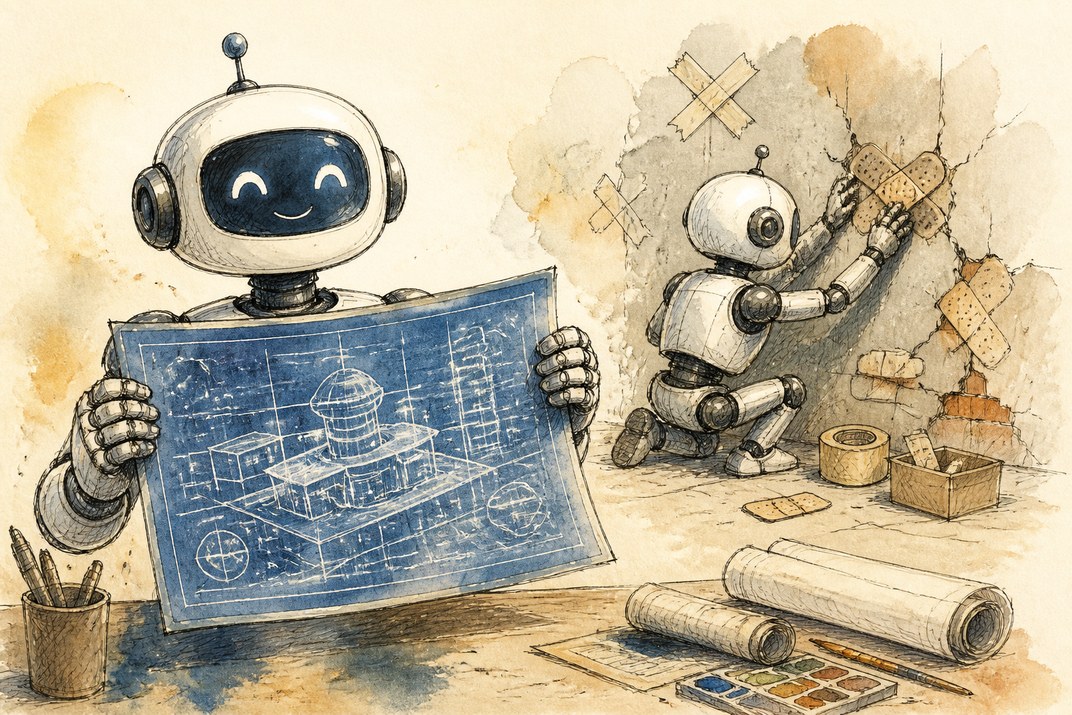
Good morning. Here is what matters in AI today, and how to put it to work.
Agentic AI is moving from prototype to production, and today's news shows both the tools and the hard limits teams must plan for.
~4 min read · last 12 hours
In today's issue
01
5 production challenges in multi-agent systems and how one team solved them
02
AI-built Adobe clones: impressive demo, not production-ready
03
OpenAI ships an official CLI
04
Hugging Face open-sources a biology model that 'speaks' DNA
05
MedPAO-Assist: a radiology report AI that runs on edge hardware
Main story
5 production challenges in multi-agent systems and how one team solved them
A detailed post names five concrete blockers that kill multi-agent AI in production: orchestration, per-agent model selection, reliable operation, secure code execution, and monitoring, then shows how Deep Insight addressed each on AWS.
Why it matters: If your team has a multi-agent prototype that stalls before go-live, this is the clearest public map of why, and what to do about it.
What to watch next: Watch whether teams that follow this pattern start publishing latency and cost benchmarks, which would give the field a shared baseline for what "production-ready" multi-agent actually means.
We are seeing a cluster of releases and analyses that all circle the same problem: building an AI agent is easy, but making it reliable, observable, and secure in production is the hard part that most teams underestimate.
BattleBots: Metal Mayhem Takes Center Stage at Fully Connected 2026
CoreWeave
How Deep Agents Manages Context: Offloading and Summarization
LangChain
The Signal
The gap between a working AI demo and a reliable production system is the defining engineering challenge of 2025, and today's items put that tension front and center. We are seeing new open-source agents and CLI tools ship alongside sober assessments of what AI-built software actually delivers today. At the same time, research is quietly closing the gap on two fronts that matter most for deployment: smarter inference infrastructure and AI that reasons over specialized domains like biology and radiology. The practical message for engineering and product leaders: invest in production hardening now, not after the demo lands.
All the best, the KYFEX team
“A developer used Claude Opus 5.5 to build open-source replacements for seven Adobe applications, promoted them across Reddit with a projection of roughly 100% pa”
InfoQ
Quick hits
From prototype to production: agents meet reality
AI-built Adobe clones: impressive demo, not production-ready
A developer used Claude Opus 5.5 to build open-source replacements for seven Adobe applications and was candid that the results are 'not anywhere close to ready', despite strong early promotion.
Why it matters: This is a useful calibration point for any leader weighing whether AI-generated software can replace production-grade tools in the near term: the honest answer from the person who tried it is still no.
OpenAI released an official command-line interface for its API, giving developers a direct terminal-based path to model calls without wrapping the REST API themselves.
Why it matters: An official CLI reduces glue-code overhead and signals that OpenAI is treating developer tooling as a first-class concern, which matters for teams standardizing their internal AI workflows.
Specialized AI: biology, radiology, and inference efficiency
Three research and product items today point to AI moving deeper into high-stakes specialized domains, where the engineering constraints are tighter and the payoff from getting inference right is much larger.
Hugging Face open-sources a biology model that 'speaks' DNA
A new open-source model from Hugging Face processes DNA sequences like language, letting researchers query the effects of genetic changes on gene activity and health outcomes.
Why it matters: Open-source foundation models for genomics lower the entry cost for biotech and pharma teams building research tools, but they also raise the stakes for responsible deployment in clinical contexts.
MedPAO-Assist: a radiology report AI that runs on edge hardware
A new agentic AI system for structuring radiology reports is designed to run on modest edge hardware without cloud dependency, addressing the gap between large proprietary models and real-world hospital infrastructure.
Why it matters: Edge-deployable medical AI matters because most hospitals cannot route patient data to cloud APIs, so on-premise capability is a prerequisite for real adoption.
Systematically improve the accuracy of LLM applications with evaluation, prompting, and memory tuning.
DeepLearning.AI · Free · 1 hour
Put it to work
Try this today
Audit a multi-agent system for the five production failure modes
I am reviewing a multi-agent AI system before production deployment. For each of the following five failure modes, describe (1) how it could manifest in my system and (2) one concrete mitigation I should implement before go-live:
1. Orchestration: agents deadlock or produce conflicting outputs 2. Per-agent model selection: wrong model tier used for a given task 3. Reliable operation: transient failures cascade across agents 4. Secure code execution: agent-generated code runs with excess privilege 5. Monitoring: failures are silent or hard to trace
My system does: [describe your system here]
Why it helps: Running this before your next production review surfaces gaps that are easy to miss in demos but expensive to fix after launch, directly mirroring the patterns documented in today's Deep Insight case study.
Before you ship it
The risk
Edge-deployed medical AI models like MedPAO-Assist operate outside the audit trails and access controls of cloud platforms, making it harder to detect when a model drifts or produces a structurally plausible but clinically incorrect report.
Do this
Establish a local logging layer that captures every model input and output with a timestamp and model version, and route a random sample to a qualified clinician for spot-check review on a defined cadence.
Ready to ship AI, not just read about it?
KYFEX designs and builds production AI for teams that need it working, not just demoed. Tell us what you're working on and we'll bring the engineering.