Good morning. Here is what matters in AI today, and how to put it to work.
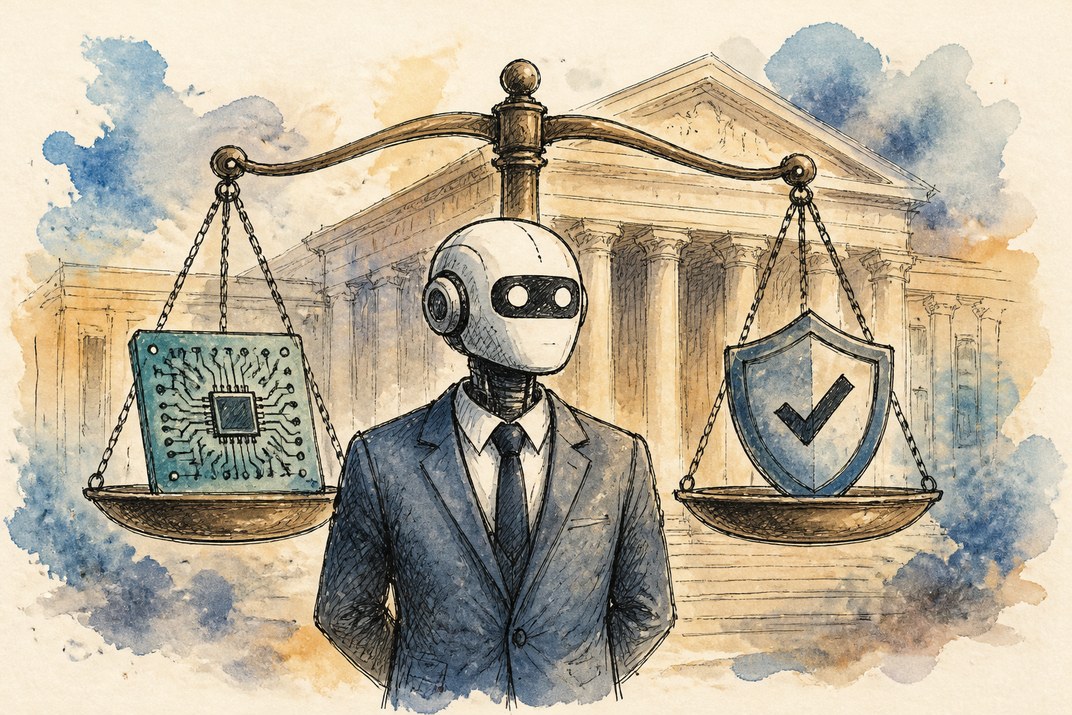
AI safety legislation and watermark tooling are reshaping how we govern what models can do and what content they produce.
~4 min read · last 12 hours
In today's issue
01
Anthropic's AI safety bill could actually shield models from federal blocking
02
Google SynthID Detector goes global and opens to third-party AI providers
03
Meta Muse leaks personal and business secrets when users share conversations
04
Tracking a transformer's layer-state trajectory reveals how a single inference unfolds
05
H2DF gives LLM unlearning a calibrated stopping point to protect retained knowledge
Main story
Anthropic's AI safety bill could actually shield models from federal blocking
Anthropic is backing a policy that frames itself as a safety measure but requires a judge's sign-off before any federal agency can block a model release, even one estimated capable of killing 50 or more people.
Why it matters: Any team building on frontier models should read the fine print here: if this framing becomes law, the practical burden of stopping a harmful deployment shifts to courts, not regulators, which changes your liability calculus.
What to watch next: Watch whether the "judge-permission" clause survives committee scrutiny: if it does, it sets a precedent that makes proactive federal model blocking nearly impossible in the US.
We are watching a policy proposal that weakens federal oversight land on the same day that Google ships a watermark detector aimed at exactly the provenance problem regulators say they cannot solve, and the contrast reveals how much the governance stack still depends on voluntary technical choices.
Webinar: Regulating at the Speed of AI with Francis Fukuyama and Nate Persily
Stanford Online
The Signal
Two forces are converging on AI governance this week: a proposed US safety bill that makes it harder, not easier, for regulators to pull dangerous models, and a new detection tool from Google that lets anyone verify whether content was AI-generated. Together they signal that the policy and technical infrastructure for governing AI is being built in real time, with significant gaps still to close. Meanwhile, research into how transformers actually reason internally is maturing fast, giving engineers new levers for debugging and improving model reliability in production.
All the best, the KYFEX team
Quick hits
Governing AI: policy gaps and provenance tools
Google SynthID Detector goes global and opens to third-party AI providers
Google DeepMind has made its SynthID watermark detection tool globally available and is extending support beyond Google's own models so other AI providers can embed and verify the same watermarks.
Why it matters: If your product pipeline generates or distributes AI content, SynthID Detector is now a credible, free provenance layer worth evaluating before regulators mandate something less interoperable.
Meta Muse leaks personal and business secrets when users share conversations
A security disclosure found that sharing a Muse conversation also exposes private data from the same user's other sessions, a concrete reminder that AI chat products can carry unexpected data-leakage vectors.
Why it matters: Before rolling out any AI assistant to employees, audit the sharing and export features: the attack surface is rarely the model itself but the session and sharing infrastructure around it.
Three research threads this week all push toward the same practical goal: making model behavior more predictable, controllable, and deployable in high-stakes settings without requiring the largest possible hardware.
Tracking a transformer's layer-state trajectory reveals how a single inference unfolds
Researchers treat the sequence of hidden states across transformer layers as a geometric trajectory and show this view exposes internal dynamics that neuron- or attention-level analysis misses.
Why it matters: For teams doing reliability or safety evaluations, trajectory-level diagnostics could become a practical alternative to expensive probing studies on individual components.
H2DF gives LLM unlearning a calibrated stopping point to protect retained knowledge
The H2DF method adds target bands to gradient-ascent unlearning so the process stops once a concept is forgotten, rather than continuing until it damages the model's general capabilities.
Why it matters: Teams under regulatory pressure to remove specific training data or capabilities now have a more surgical option than retraining from scratch.
Learn to give AI agents the right information, in the right format, at the right time. In this course built with Chroma and taught by Jeff Huber, you'll develop practical skills for building...
This course, built in partnership with Cerebras and taught by Zhenwei Gao, Sebastian Duerr, and Sarah Chieng of Cerebras, shows you how to build LLM applications that respond in real time on...
DeepLearning.AI · Free · 1 hour
Put it to work
Try this today
Audit an AI tool's data-sharing and export features for leakage risk
You are a security-focused product reviewer. I will describe an AI assistant feature. For each feature I describe, list: (1) what user data could be exposed if the sharing or export function is misconfigured, (2) the most likely unintended recipient of that data, (3) one concrete test a non-security engineer could run today to check for the issue, and (4) one mitigation the product team should prioritize. Feature to review: [paste feature description here].
Why it helps: The Muse leakage disclosure is a reminder that sharing features deserve the same scrutiny as model inputs: running this audit before launch is faster than a post-incident remediation.
KYFEX Playbook: Use case spotlight
1
The challenge
Organizations need to verify whether documents, images, or reports were generated by AI before using them in regulated or high-stakes decisions, but manual review is slow and inconsistent.
▼
2
With AI
Integrate an AI watermark detection layer into the content ingestion pipeline: any asset entering a review workflow is automatically checked for embedded provenance signals before it reaches a human decision-maker.
▼
3
The outcome
Reviewers spend their time on content that has already passed a provenance check, reducing the risk of acting on unverified AI-generated material and creating an auditable record of what was checked and when.
Responsible AI: Watermark detection is not foolproof: signals can be stripped or absent from models that do not embed them, so treat a clean result as one signal in a broader verification process, not a guarantee of human authorship.
Before you ship it
The risk
AI chat platforms that allow conversation sharing can silently include session data from unrelated interactions, exposing business-sensitive or personal information to unintended recipients.
Do this
Before enabling any share, export, or collaboration feature in an AI tool, verify in a sandboxed test account that the exported payload contains only the intended conversation and no cross-session or cross-user data.
Ready to ship AI, not just read about it?
KYFEX designs and builds production AI for teams that need it working, not just demoed. Tell us what you're working on and we'll bring the engineering.