Good morning. Here is what matters in AI today, and how to put it to work.
AI agents are reaching into binary code and genomics, but data gaps and infrastructure consolidation are the real forces shaping your roadmap today.
~3 min read · last 12 hours
In today's issue
01
Amazon acquires DuckLabs and brings DuckDB into Aurora PostgreSQL
02
Open-source project brings AI agents to binary reverse engineering
03
Why AI still cannot decode the full complexity of the human genome
04
DeepSeek releases V4.1-Flash-1017, a new fast inference model
Main story
Amazon acquires DuckLabs and brings DuckDB into Aurora PostgreSQL
Amazon has bought DuckLabs, the company behind the popular embedded analytical database DuckDB, and is integrating it directly into Amazon Aurora PostgreSQL.
Why it matters: This narrows the gap between transactional and analytical workloads inside a single managed database, which matters for AI pipelines that need fast in-place aggregations without spinning up a separate warehouse.
What to watch next: Watch whether other cloud providers respond by deepening their own embedded-analytics integrations, and whether DuckDB's open-source community governance changes under Amazon ownership.
A new DeepSeek flash model and Amazon's acquisition of DuckLabs both signal that the infrastructure layer of AI is consolidating fast, with speed and analytical depth as the twin pressures.
New Model: Reflection Beam is a new Open Weight Model
Hugging Face
Stanford EE292R AI and Data for Science | Autumn 2026 | Models of Computation in the Retina
Stanford Online
The Signal
Today's items collectively point to a maturing AI stack where the hard limits are data and infrastructure, not raw model capability. Amazon folding DuckDB into Aurora is a quiet but consequential infrastructure move: it reduces friction for the fast analytical queries that feed AI pipelines. At the same time, the genomics story is a useful corrective to capability hype, reminding us that even well-funded domains stall when ground-truth training data is scarce. For engineering leaders, the practical signal is consistent: invest in data quality and pipeline efficiency now, because model improvements alone will not unlock the next tier of value.
All the best, the KYFEX team
Quick hits
AI agents push into low-level and biological complexity
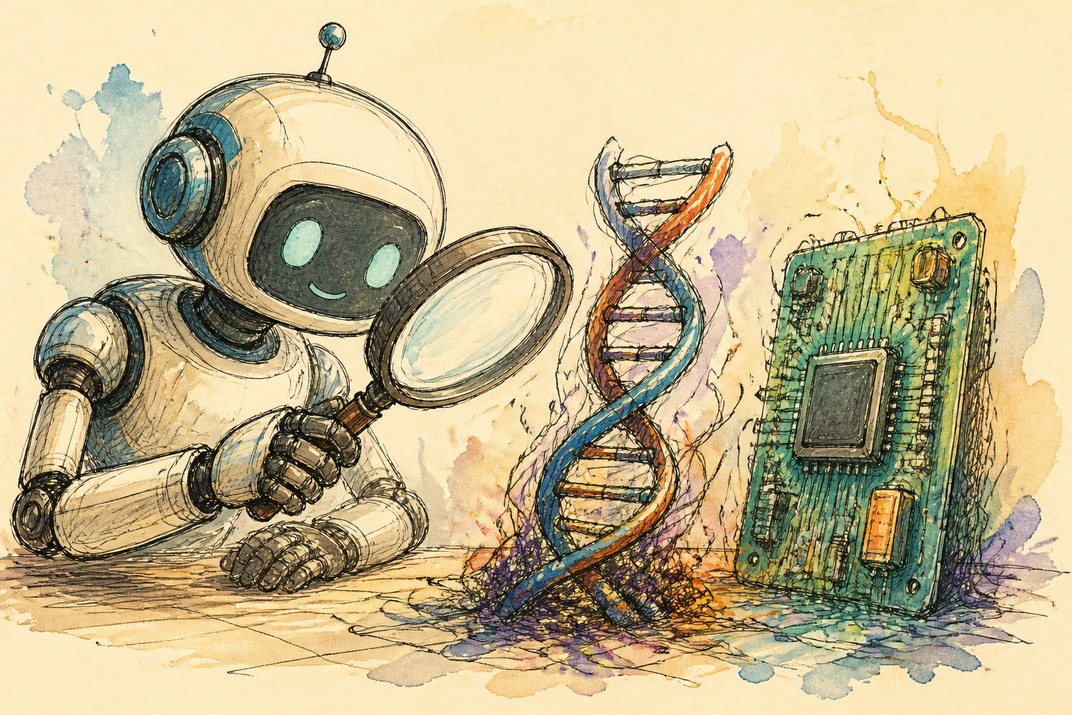
Two stories today show AI tooling reaching into domains long considered too opaque for automation: binary code analysis and the human genome, and in both cases the gap between ambition and readiness is the real story.
Open-source project brings AI agents to binary reverse engineering
Reverse Engineer Anything (REA) has crossed 200K GitHub stars by wiring coding agents into binary analysis workflows, letting teams interrogate compiled code without source.
Why it matters: If your security or platform team still relies on manual binary analysis, REA is worth a serious evaluation spike: agent-assisted workflows can dramatically cut triage time on unknown binaries.
Why AI still cannot decode the full complexity of the human genome
DNA is far more dynamic than a static instruction set, and current AI models lack the training data needed to interpret that complexity reliably.
Why it matters: Teams building in genomics or clinical AI should treat this as a data-quality warning: model capability is not the bottleneck right now, ground-truth biological data is.
Infrastructure moves: new models and a database acquisition
DeepSeek releases V4.1-Flash-1017, a new fast inference model
DeepSeek has published DeepSeek-V4.1-Flash-1017 on Hugging Face, continuing its cadence of releasing capable, low-latency open-weight models.
Why it matters: For teams running cost-sensitive inference at scale, each new DeepSeek flash release is a benchmark moment: test it against your current serving stack before assuming your cost baseline is fixed.
Become an AI power user in this new course taught by Andrew Ng. From finding information to building apps, you'll develop the prompting skills that get real, useful results from today's most...
Build smarter search and RAG applications for multimodal retrieval and generation.
DeepLearning.AI · Free · 1 hour
Put it to work
Try this today
Assess a binary or compiled artifact for security risks
You are a security-focused reverse engineering assistant. I will paste a disassembled function or binary excerpt below. Your tasks: 1. Identify any suspicious patterns (e.g. unsafe memory operations, hardcoded credentials, obfuscated strings). 2. Summarise what the code appears to do in plain English. 3. List the top three questions a human analyst should investigate next.
Binary/disassembly excerpt: [PASTE HERE]
Why it helps: With AI-assisted binary analysis tools like REA gaining traction, this prompt gives your team a fast first-pass triage workflow using any capable coding-focused model today.
Before you ship it
The risk
AI-assisted binary analysis can surface false positives or miss obfuscated malicious patterns, and acting on unverified findings in a production security context can cause real harm.
Do this
Treat AI binary analysis output as a prioritised lead list, not a verdict: route every flagged finding through a human analyst before any remediation or escalation action is taken.
Ready to ship AI, not just read about it?
KYFEX designs and builds production AI for teams that need it working, not just demoed. Tell us what you're working on and we'll bring the engineering.