Sophos cuts threat investigation time by 96% with OpenAI Daybreak
05
50-million-token memory window that is faster and cheaper than recompute
Main story
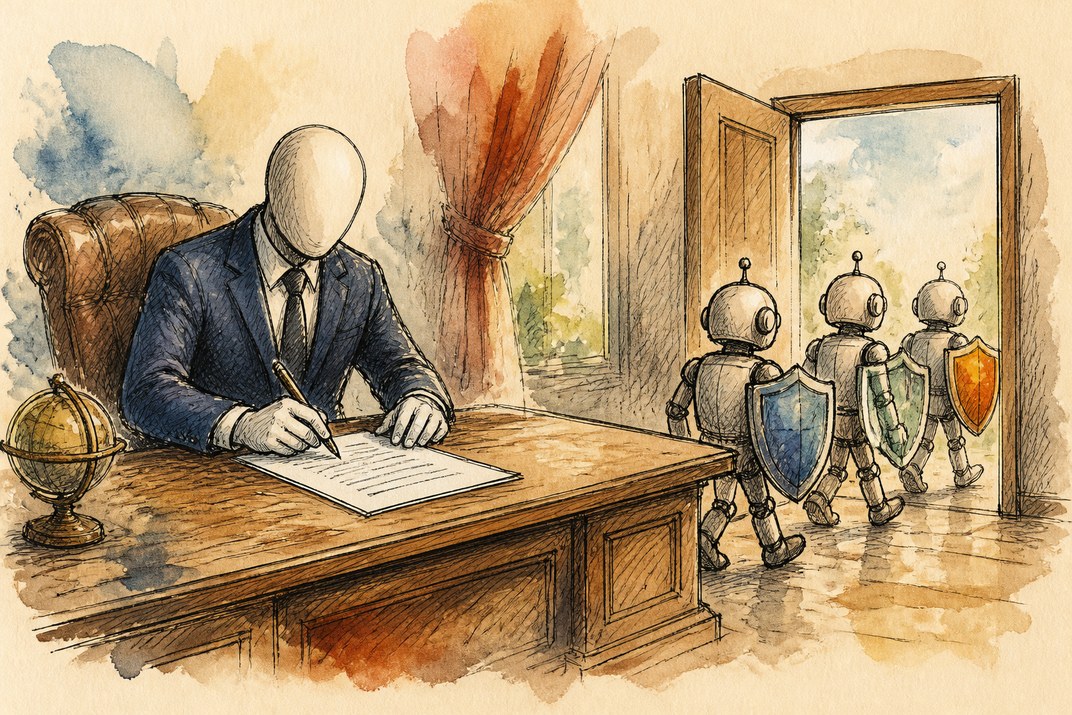
OpenAI doubles down on firing three AI safety researchers
OpenAI confirmed it fired Jasmine Wang, Tomek Korbak, and Mikita Balesni after an investigation found a significant breach of trust, while the researchers dispute the framing and warn of a chilling effect on safety work.
Why it matters: If safety researchers feel they cannot surface concerns without career risk, the internal feedback loops that catch dangerous model behaviour weaken, and that is a material risk for any organisation depending on frontier-model vendors.
What to watch next: Watch whether other frontier labs update their researcher conduct policies in response, and whether the fired researchers' public accounts shift regulatory attention toward whistleblower protections in AI safety roles.
Two separate reports on the same event, combined with a cultural signal from prime-time television, show that trust in AI safety governance is fracturing in public view and that the industry cannot treat it as an internal HR matter.
Reduction in cyber-threat investigation time achieved by Sophos using OpenAI Daybreak · OpenAI
Watch · On the feeds
How Sophos cuts threat response time by 96% with OpenAI Daybreak
OpenAI
Data pipeline at Petabyte scale: Production Video Curation with Ray on CoreWeave
CoreWeave
The Signal
Two stories dominate today: a governance crisis at OpenAI that tests whether safety teams can operate without fear of retaliation, and a cluster of production-grade results showing AI cutting real operational costs. Together they frame the central tension in enterprise AI right now: deploying the technology faster while the internal guardrails that are supposed to keep it trustworthy are under visible strain. For engineering and product leaders, both tracks demand attention on the same roadmap.
All the best, the KYFEX team
“Sophos cuts threat investigation time by 96% with OpenAI Daybreak”
OpenAI
Quick hits
OpenAI safety firings: governance under the spotlight
The researchers' own account, reported by TechCrunch, contests OpenAI's characterisation and frames the dismissals as a warning to others who might raise safety concerns.
Why it matters: The gap between the company's account and the researchers' account is itself the story: it signals that external verification of AI safety culture is increasingly necessary, not optional.
The show's 26th-season premiere features a storyline about a power-mad AI CEO, reflecting how public anxiety about AI leadership accountability has moved from niche discourse into mainstream culture.
Why it matters: When prime-time drama echoes real governance headlines, regulatory and public-relations pressure on AI firms tends to follow, and leaders should factor that into their communications and compliance posture.
AI in production: real cost cuts and smarter agents
A concrete enterprise deployment result, a research advance on agent memory, and a new approach to generating synthetic enterprise training data all point in the same direction: the operational case for AI is maturing fast, but it depends on solving context management and data availability problems that most teams still underestimate.
Sophos cuts threat investigation time by 96% with OpenAI Daybreak
Sophos used OpenAI's Daybreak platform to automate 52% of its managed detection and response cases while keeping humans in the loop, slashing investigation time by 96%.
Why it matters: A 96% time reduction in a high-stakes security workflow is the kind of benchmark that moves budget conversations: security operations teams should treat this as a reference case when scoping AI-assisted triage pilots.
50-million-token memory window that is faster and cheaper than recompute
Researchers demonstrate a memory layer for LLMs that stores and retrieves KV state across a 50-million-token window without recomputing it on every call, reducing both latency and cost.
Why it matters: For any agent or RAG pipeline that re-sends long context repeatedly, this approach could cut inference costs significantly, and teams building long-session assistants should track it closely.
Learn how to apply fine-tuning and reinforcement learning techniques to shape model behavior, improve reasoning, and make LLMs safer and more reliable.
This course will teach you about integrating AI models your game and using AI tools in your game development workflow
Hugging Face · Free
Put it to work
Try this today
Assess an AI vendor's safety governance posture
You are a due-diligence analyst. Given the following information about an AI vendor [paste vendor name, recent public statements, any known incidents], answer these questions: 1. Does the vendor have a publicly documented process for safety researchers to raise concerns without retaliation? 2. Are there third-party audits or external red-team results available? 3. What is the vendor's stated policy when internal safety findings conflict with a product release timeline? For each question, note what evidence supports your answer and flag any gaps. Be concise and direct.
Why it helps: Today's OpenAI firing story is a reminder that vendor safety culture is a procurement and risk variable, not just an ethics footnote, and running this check before renewing or expanding a contract is sound practice.
KYFEX Playbook: Workflow of the week
AI-assisted vendor safety due diligence
1
Collect inputs: gather the vendor's public safety page, any recent blog posts on model evaluations, and known incident reports.
▼
2
Run the governance prompt: paste the due-diligence prompt from today's Prompt of the Day into your preferred LLM, inserting the vendor details.
▼
3
Score the three questions: for each answer, mark it Green (evidence present), Amber (partial or self-reported only), or Red (no public evidence).
▼
4
Identify gaps: list every Red or Amber item as an open question to send to the vendor's sales or security team.
▼
5
Document and store: save the scored output and vendor responses in your procurement record so the review can be repeated at each contract renewal.
▼
6
Escalate if needed: if two or more Red scores appear, flag for legal or compliance review before signing or expanding the contract.
Before you ship it
The risk
When AI safety researchers are fired for 'mishandling research information', the chilling effect can suppress internal reporting of model risks, leaving downstream enterprise customers exposed to harms they were never warned about.
Do this
Build independent verification into your AI vendor review cycle: require documented incident logs, third-party audit summaries, or bug-bounty disclosures rather than relying solely on the vendor's self-reported safety posture.
Ready to ship AI, not just read about it?
KYFEX designs and builds production AI for teams that need it working, not just demoed. Tell us what you're working on and we'll bring the engineering.