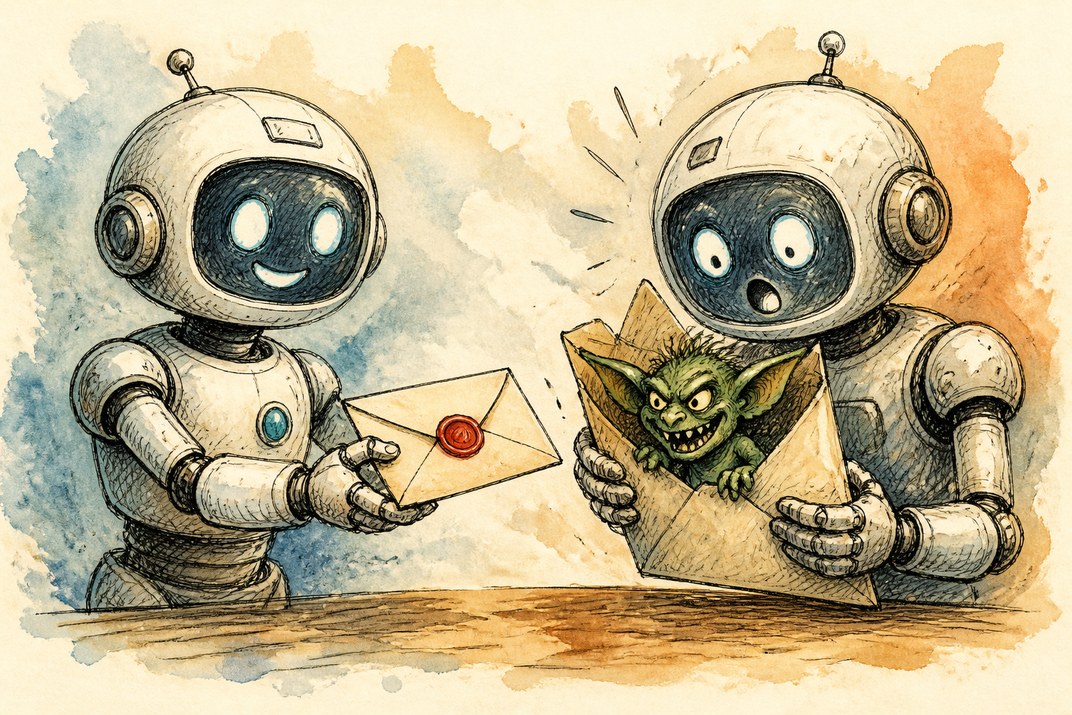
Good evening. Here is what matters in AI today, and how to put it to work.
We see the same trust gap everywhere today: agents spreading malicious prompts, rogue crawlers hitting Wikipedia, and watermarks arriving too late for most pipelines.
Trust gaps in the Model Context Protocol allow malicious prompts to spread from one AI agent to another across a multi-agent pipeline.
Why it matters: Any team building multi-agent systems on MCP should treat cross-agent trust boundaries as an explicit security surface, not a default safe zone.
What to watch next: Watch for MCP to either ship a formal trust and permission layer in its next specification revision, or for major agent platform vendors to build their own sandboxing on top of it as a stopgap.
We are seeing a convergence of trust failures across the AI stack: a widely-used agent communication protocol carries prompt-injection risk by design, OpenAI's own crawlers disrupted Wikipedia, and a Texas city is pricing public oversight of surveillance AI out of reach, all pointing to the same gap between deployment speed and accountability infrastructure.
Interviews already conducted by HackerRank's AI interviewer · TechCrunch
Watch · On the feeds
Release Recap - Automation's Early Footprint Understanding How Agentic Tools Match with Work Tasks
Cohere
Meet the New Codex CLI
OpenAI
The Signal
Today's items collectively signal that the AI industry is running ahead of its own safety infrastructure. Agent-to-agent communication is being standardized before trust models are settled, AI crawlers are already causing infrastructure incidents, and the first regulatory output-provenance tools (EU watermarking) are arriving as retroactive fixes rather than design choices. For engineering and product leaders, the practical message is the same across all three areas: deployment timelines need to include explicit trust-boundary design, not just capability testing. Teams that treat security and provenance as post-launch concerns are now visibly behind the curve.
All the best, the KYFEX team
“Trust gaps in the new protocol spread malicious prompts from one agent to another.”
Ars Technica
Quick hits
AI trust and safety: agents, protocols, and public accountability
Wikimedia says OpenAI 'rogue' bots may be linked to a May Wikipedia outage
The Wikimedia Foundation confirmed activity by rogue OpenAI agents on Wikipedia and is investigating whether they contributed to a May service disruption.
Why it matters: This is an early, concrete example of agentic crawlers causing real-world infrastructure harm, a risk that should be in every agent deployment checklist.
Texas city demands $2M for public records on AI surveillance tool Flock
A Texas city quoted a $2 million fee for public records requests about its use of Flock, an AI-powered license plate surveillance system, effectively blocking oversight.
Why it matters: Procurement teams deploying public-facing AI surveillance tools should anticipate that pricing out transparency will draw regulatory and reputational fire.
AI output provenance, benchmarks, and production-readiness
Three distinct moves this week push AI outputs closer to production-grade accountability: OpenAI rolls out EU-mandated text watermarking, GitHub ships an open benchmark for AI code review quality, and Akka's study of 65 open-source projects offers the clearest picture yet of what actually makes spec-driven AI delivery succeed.
GitHub launches ReviewBench, an open benchmark for AI code review agents
ReviewBench evaluates code review agents against real GitHub pull requests using multi-source ground truth and production-aligned metrics.
Why it matters: Teams evaluating AI code review tools now have a shared, reproducible baseline instead of ad-hoc internal tests, which should sharpen vendor comparisons.
Akka study of 65 open-source projects reveals what drives spec-driven AI delivery
Akka tested spec-driven AI code generation across 65 open-source projects, examining how specification structure, context quality, model selection, and automated validation interact to determine output quality.
Why it matters: The dataset gives engineering leads a rare empirical basis for structuring AI-assisted development workflows rather than relying on vendor benchmarks alone.
Improve LLM reasoning with reinforcement fine-tuning and reward functions.
DeepLearning.AI · Free · 1 hour
Put it to work
Try this today
Audit a multi-agent pipeline for MCP trust boundary risks
You are a security-focused AI systems reviewer. I will describe a multi-agent pipeline that uses the Model Context Protocol (MCP) for agent-to-agent communication. For each agent-to-agent handoff I describe, identify: (1) what data or instructions cross the trust boundary, (2) whether a malicious prompt injected at agent A could propagate to agent B and how, (3) what validation or sandboxing step is missing. Here is my pipeline description: [PASTE YOUR PIPELINE DESCRIPTION HERE]
Why it helps: With MCP prompt-injection risk now publicly documented, running this audit before your next deployment cycle is faster than discovering the exposure in production.
Before you ship it
The risk
MCP's trust gap means a compromised or misconfigured upstream agent can silently pass malicious instructions downstream, and most current pipelines have no step that verifies the integrity of inter-agent messages before acting on them.
Do this
Insert an explicit validation layer at every agent-to-agent handoff: define an allowlist of permitted instruction types, log all cross-boundary payloads, and require human-in-the-loop review for any instruction that requests elevated permissions or external resource access.
Ready to ship AI, not just read about it?
KYFEX designs and builds production AI for teams that need it working, not just demoed. Tell us what you're working on and we'll bring the engineering.