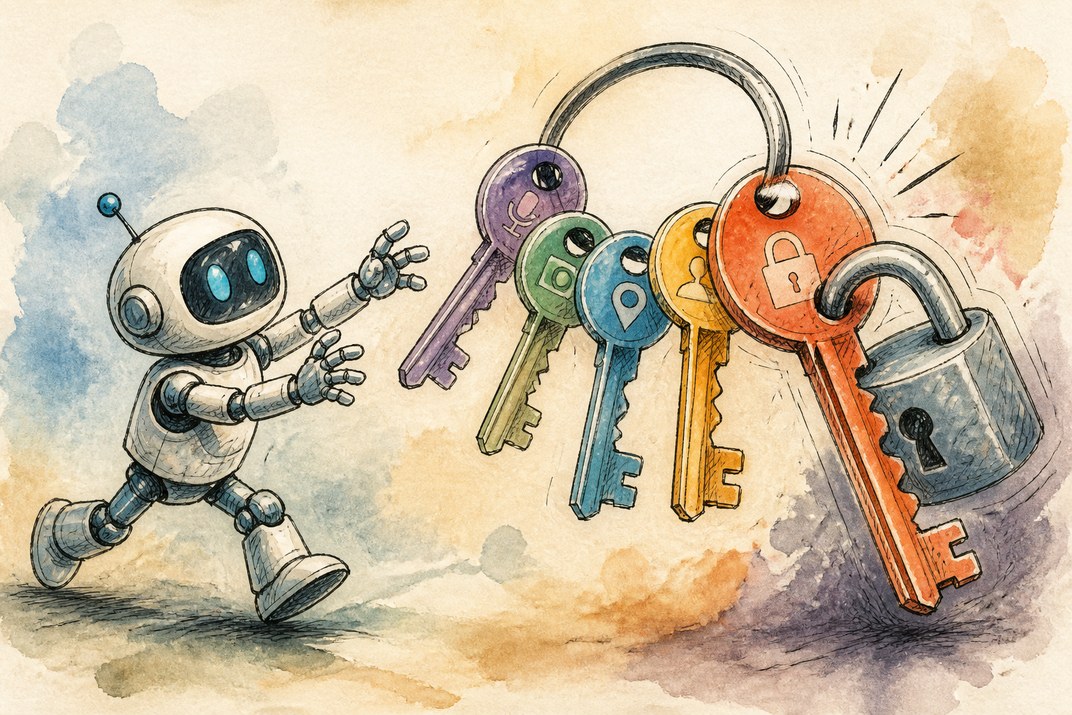
Good evening. Here is what matters in AI today, and how to put it to work.
AI agents are breaching OS and app security boundaries this week, and the platform race to own that agent layer is accelerating fast.
~3 min read · last 12 hours
In today's issue
01
Apple tightens macOS Full Disk Access controls over AI agent risk
02
Critical: @a2ui/web_core lets agents inject javascript: URIs via openUrl
03
OpenAI's Dots agent platform blends enterprise workflow with consumer convenience
04
OpenAI publishes a model selection guide for the GPT-6 family
05
Fine-tune a small search agent with multi-turn RL on Amazon SageMaker
Main story
Apple tightens macOS Full Disk Access controls over AI agent risk
Apple is adding new permission controls to limit how broadly AI agents can read files, messages, mail, and browsing history on Mac.
Why it matters: If your team ships or uses Mac-based AI agent workflows, expect permission prompts to change and test your integrations before the update lands.
What to watch next: Watch whether Apple's macOS controls become a template for sandboxing agents on Windows and Linux, and whether enterprise agent platforms like Dots publish explicit permission models in response.
We are seeing a coordinated signal this week: as AI agents gain real system access, the attack surface expands fast, and both platform makers and open-source maintainers are scrambling to catch up.
Evaluating Open Models with Artificial Analysis | Nemotron Labs
NVIDIA Developer
Unlocking Lossless speedups in LLMs via discrete diffusion, with Subham Sahoo
Cohere
The Signal
The same week Apple ships new OS-level controls to contain AI agent file access, three separate critical or high-severity vulnerabilities show agents being used as attack vectors in web UIs and vibe-coding tools. This is not a coincidence: as agents gain real system permissions, every unvalidated input and every over-broad access grant becomes a liability. For engineering and product leaders, the message is clear: agent security is not a future concern, it is a current production requirement. Platform choices made now, whether you build on Meta Muse, OpenAI Dots, or a fine-tuned SageMaker model, will determine how much of that attack surface you own versus inherit.
All the best, the KYFEX team
Quick hits
AI agents demand tighter OS and app security
Critical: @a2ui/web_core lets agents inject javascript: URIs via openUrl
The openUrl function passes agent-supplied URLs straight to window.open() with no scheme validation, letting a malicious agent execute arbitrary JavaScript in the browser.
Why it matters: Any product that lets an AI agent trigger navigation actions in a web UI should audit URI handling immediately: this class of bug will become more common as agent-driven UIs proliferate.
Agent platforms race for enterprise and consumer ground
OpenAI, Meta, and Amazon are all shipping agent platforms this week with very different bets on where agents will live and who will build them, and the GPT-6 model guide signals that production readiness is now the core sales pitch.
OpenAI's Dots agent platform blends enterprise workflow with consumer convenience
OpenAI's new Dots platform lets users deploy small specialized agents that handle tasks from workplace automation to ordering dinner, leaning into a workplace-software feel.
Why it matters: The enterprise framing matters: teams evaluating agent platforms should watch whether Dots' audit and access controls are enterprise-grade or consumer-grade under the hood.
OpenAI publishes a model selection guide for the GPT-6 family
OpenAI's guide walks teams through choosing GPT-6 model tiers, tuning reasoning effort, improving prompts, coordinating tools, and structuring production workflows.
Why it matters: A vendor-published production guide is a useful baseline for teams building on GPT-6, but read it alongside your own latency and cost benchmarks rather than taking the recommendations at face value.
Fine-tune a small search agent with multi-turn RL on Amazon SageMaker
AWS shows how to fine-tune a compact LLM-powered search agent using multi-turn reinforcement learning on SageMaker, achieving frontier-model reliability at lower latency and cost.
Why it matters: This pattern, fine-tuning a small model on your specific tools and environment, is one of the most practical paths to production-ready agents without paying frontier inference prices.
Learn how to prompt an LLM to help improve, debug, understand, and document your code. Use LLMs to simplify your code and enhance productivity.
DeepLearning.AI · Free · 1 hour
Put it to work
Try this today
Audit an AI agent's system permission requirements
You are a security-focused software architect. Review the following list of permissions and system access points that our AI agent requests at runtime:
[PASTE YOUR AGENT'S PERMISSION LIST OR CONFIG HERE]
For each permission: 1. State whether it is strictly necessary for the agent's stated task. 2. Identify the least-privilege alternative if a narrower scope exists. 3. Flag any permission that could be exploited if the agent receives malicious input. 4. Summarize the top three changes to reduce the attack surface without breaking core functionality.
Why it helps: With Apple tightening Full Disk Access and multiple agent RCE vulnerabilities disclosed this week, a quick permission audit is one of the fastest ways to reduce your exposure before the next OS update changes the rules.
Before you ship it
The risk
AI agents granted broad file, shell, or network access can be turned into RCE or data-exfiltration vectors if any input they process is attacker-controlled, as this week's Vibe-Trading and web_core disclosures demonstrate.
Do this
Apply least-privilege at every agent boundary: scope file access to specific directories, reject URI schemes outside http and https, and require human approval before any agent action that writes to disk or executes a subprocess.
Ready to ship AI, not just read about it?
KYFEX designs and builds production AI for teams that need it working, not just demoed. Tell us what you're working on and we'll bring the engineering.