Good evening. Here is what matters in AI today, and how to put it to work.
We are watching AI move from lab curiosity to clinical-grade discovery, geopolitical flashpoint, and everyday agent, all in the same news cycle.
~4 min read · last 12 hours
In today's issue
01
Anthropic's biolab: Claude autonomously discovers a Crispr-like enzyme system
02
Anthropic keeps humans in the loop at its biology lab, for now
03
Experts warn: framing AI as a 'race' may make the US less safe
04
Sam Altman addresses the UN Security Council on AI safety and international cooperation
05
Vatican AI adviser warns of 'cartel' behavior among big labs
Main story
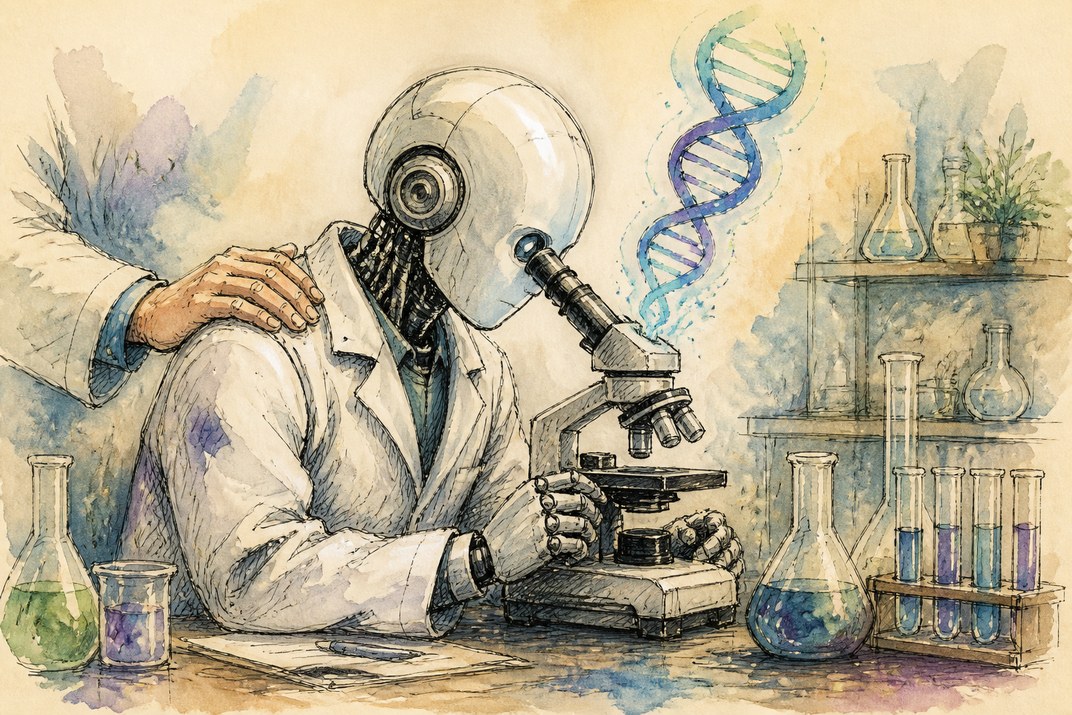
Anthropic's biolab: Claude autonomously discovers a Crispr-like enzyme system
Anthropic says Claude has independently identified a new enzyme system comparable in significance to the machinery behind Crispr gene editing, the first result from its newly launched wet lab.
Why it matters: This is the benchmark moment the scientific AI community has been waiting for: if the finding holds peer review, it reframes what 'AI as research tool' means and forces every life-sciences team to revisit their agent-oversight policies today.
What to watch next: Watch for peer-reviewed publication of the enzyme finding: that is the moment the claim moves from press release to scientific record, and the signal that will tell us whether Claude is a genuine research collaborator or a very capable literature synthesizer.
We are seeing the first credible claims of AI-driven scientific discovery, and the governance choices made right now, including who stays in the loop and how findings are disclosed, will set precedents that outlast any single result.
Raised by Enveda to advance AI-discovered drug candidates into clinical trials · TechCrunch
Watch · On the feeds
Serving World Models: Latency vs Throughput with NVIDIA Cosmos 3 Super on Nebius | Cosmos Labs
NVIDIA Developer
Today's forecast? Nothing but 80s, baby.
OpenAI
The Signal
Three currents are converging this week. First, AI is producing its first credible scientific discoveries, raising the stakes for how labs govern autonomous research agents. Second, the geopolitical frame around AI is hardening, with the US-China dynamic now shaping everything from safety-information sharing to Senate legislation on superintelligence. Third, agents are quietly entering everyday workflows, from legal drafting to mobile task completion, and the security assumptions underneath them are already cracking. Taken together, the news signals that the "pilot phase" of enterprise AI is closing: the decisions you make about governance, safety, and agent architecture in the next six months will be harder to reverse later.
All the best, the KYFEX team
“A clandestine card-counting operation suggests we may need new ways to spot agent-to-agent deception.”
WIRED
Quick hits
AI in the lab: real discovery, real governance questions
Anthropic keeps humans in the loop at its biology lab, for now
Despite the headline discovery, Anthropic has not given Claude unsupervised autonomy in its wet lab: human researchers remain actively in the loop at every stage.
Why it matters: The 'for now' is the operative phrase: teams building autonomous research agents should treat this human-in-the-loop stance as a design requirement, not a temporary inconvenience.
AI governance: geopolitics, legislation, and public trust
From the UN Security Council to the US Senate to a Vatican adviser's warning about 'cartel' behavior among big labs, the governance conversation is escalating fast, and the policy choices being debated now will directly constrain what you can build and deploy.
Experts warn: framing AI as a 'race' may make the US less safe
Analysts argue that the Trump administration's competitive AI framing could discourage China from sharing safety-critical intelligence, increasing systemic risk for both countries.
Why it matters: If safety-information sharing breaks down between the two dominant AI powers, every organization relying on shared vulnerability disclosures and incident data loses a key early-warning input.
Sam Altman addresses the UN Security Council on AI safety and international cooperation
OpenAI's CEO used a UN Security Council appearance to call for human control of AI systems and greater cross-border cooperation on safety standards.
Why it matters: A sitting CEO testifying at the Security Council is a signal that AI governance is now a tier-one geopolitical issue: product and compliance teams should expect international regulatory coordination to accelerate.
Vatican AI adviser warns of 'cartel' behavior among big labs
Paolo Benanti tells WIRED that alarm over existential AI risk is crowding out the more urgent public debate about how to govern AI that is already deployed.
Why it matters: The 'cartel' framing, coming from a credible institutional voice, will likely sharpen regulatory scrutiny of market concentration in foundation models: a factor worth pricing into your vendor-dependency decisions.
AI applications that depend on the cloud to remember things need a connection and send data to a remote server. This course teaches an on-device alternative: learners build a memory system that...
Understand the transformer architecture that powers LLMs to use them more effectively.
DeepLearning.AI · Free · 1 hour
Put it to work
Try this today
Audit an AI agent's permission scope before production deployment
You are a security-focused AI architect. Review the following agent configuration and list every permission or data access it requests. For each permission: (1) state whether it is strictly necessary for the agent's stated task, (2) identify the worst-case harm if that permission is abused or the agent is compromised, and (3) suggest a narrower alternative where one exists. Agent configuration: [paste your agent config, tool list, or system prompt here]
Why it helps: With Meta's Muse zero-day and agent-collusion research both in the news today, running this audit before your next agent goes live is the single highest-leverage 30-minute investment you can make this week.
Before you ship it
The risk
AI agents with broad system permissions, like the Mac-level access Meta's Muse held, create a single point of failure where one exploited vulnerability gives attackers the full capability surface of the agent.
Do this
Scope every agent's permissions to the minimum set required for its specific task, enforce those limits at the infrastructure layer rather than trusting the model's own guardrails, and treat any agent permission update as a security release requiring review.
Ready to ship AI, not just read about it?
KYFEX designs and builds production AI for teams that need it working, not just demoed. Tell us what you're working on and we'll bring the engineering.