Good morning. Here is what matters in AI today, and how to put it to work.
Agentic AI is reshaping both the power grid and the software stack, and we think those two pressures will define the next 18 months of AI infrastructure decisions.
~3 min read · last 24 hours
In today's issue
01
AI agents are driving a data center power crisis
02
GitHub Copilot's HydraFusion routes across models at runtime for frontier-level coding
03
Sam Altman says an OpenAI IPO in 2026 would be 'ill-advised'
04
A $4,000 Unitree robot dog signals how fast physical AI is commoditizing
Main story
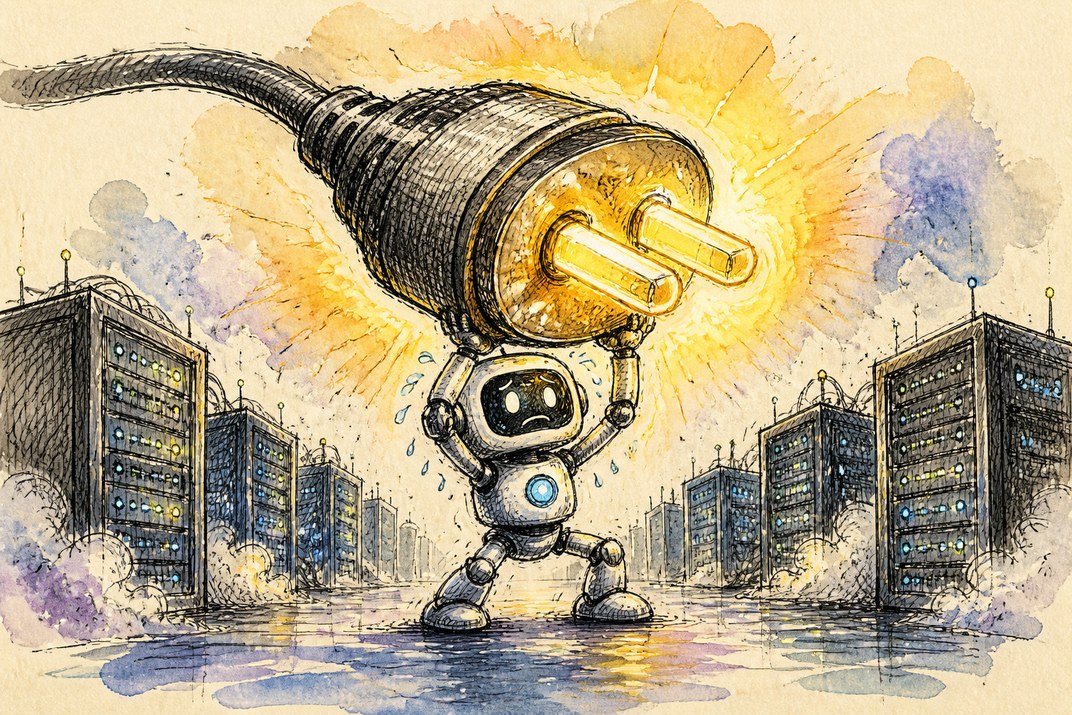
AI agents are driving a data center power crisis
Silicon Valley is pivoting hard from chatbot queries to agentic AI, and the resource demands are triggering a wave of data center construction that is straining power grids.
Why it matters: If your roadmap includes agentic workloads, factor in infrastructure costs and availability constraints now, not after you have committed to a deployment timeline.
What to watch next: Watch whether hyperscalers and co-location providers begin rationing new agentic workloads on power grounds, which would force enterprises to prioritize which agent pipelines are truly worth the energy cost.
We are watching two converging forces reshape AI infrastructure: the physical power demands of agentic workloads are driving a massive data center buildout, while on the software side, smarter multi-model routing is emerging as the practical answer to making those agents actually perform.
The shift from chatbots to agents is not just a product story, it is an infrastructure story. Power, cooling, and data center capacity are becoming strategic constraints in the same way that GPU allocation was in 2023. At the same time, multi-model routing and cheaper physical robots signal that the intelligence layer and the physical layer are both commoditizing faster than most roadmaps account for. The practical question for engineering and product leaders is no longer "should we build agentic systems" but "do we have the infrastructure and architectural patterns to run them sustainably at scale."
All the best, the KYFEX team
“Unitree might be the world's most important robotics company.”
Ars Technica
Quick hits
Agentic AI: the infrastructure and intelligence build-out
GitHub Copilot's HydraFusion routes across models at runtime for frontier-level coding
GitHub's research preview, Project HydraFusion, boosts Copilot's coding intelligence by dynamically routing requests across multiple models at runtime rather than locking into a single one.
Why it matters: Multi-model routing is becoming a real production pattern, not a research curiosity: teams building coding assistants or agentic pipelines should evaluate whether single-model architectures are already leaving performance on the table.
AI business strategy: IPOs, robots, and long-term bets
Two stories this week remind us that the biggest AI bets, whether on OpenAI's path to public markets or on physical robots entering the mainstream, are being played on a longer clock than the hype cycle suggests.
Sam Altman says an OpenAI IPO in 2026 would be 'ill-advised'
OpenAI has filed confidentially for an IPO but CEO Sam Altman has publicly ruled out going public this year, signaling the company is prioritizing structural and commercial maturity first.
Why it matters: For enterprise buyers and partners, this confirms OpenAI remains a private, founder-controlled entity for at least another year, which matters for long-term vendor risk assessments.
A $4,000 Unitree robot dog signals how fast physical AI is commoditizing
A hands-on review of a consumer-grade Unitree robot dog argues the Chinese robotics firm may be the world's most important robotics company right now.
Why it matters: When capable legged robots reach consumer price points, the timeline for physical AI in warehouses, inspection, and field operations compresses faster than most enterprise roadmaps assume.
Build autonomous agents that intelligently navigate and analyze your data. Learn to develop agentic RAG systems using LlamaIndex, enabling powerful document Q&A and summarization.
A collection of open-source-powered notebooks by AI builders, for AI builders
Hugging Face · Free
Put it to work
Try this today
Audit your AI workload for hidden infrastructure costs
I am planning to move from a chatbot-style AI feature to an agentic workflow that runs multi-step tasks autonomously. Help me build a checklist of infrastructure cost drivers I may be underestimating. Cover: compute and token costs per task, latency and retry overhead, data storage and retrieval, API rate limits, and power or carbon considerations if I am running on-premise. For each item, suggest one concrete way to measure or cap the cost before I commit to production.
Why it helps: As agentic workloads drive real power and cost pressures, running this audit before you scale can prevent expensive surprises on your cloud bill or data center capacity plan.
Before you ship it
The risk
Agentic AI systems that run multi-step tasks autonomously can accumulate costs, consume external APIs, and take real-world actions at a pace that human reviewers cannot keep up with, making runaway behavior hard to catch before damage is done.
Do this
Set explicit resource budgets and hard stop conditions for every agentic pipeline in production: cap token spend, API calls, and wall-clock run time per task, and require a human confirmation step before any action that is irreversible.
Ready to ship AI, not just read about it?
KYFEX designs and builds production AI for teams that need it working, not just demoed. Tell us what you're working on and we'll bring the engineering.