Good evening. Here is what matters in AI today, and how to put it to work.
We are watching AI safety move from lab culture to formal governance, just as frontier model capabilities publicly cross into expert-level reasoning.
~4 min read · last 12 hours
In today's issue
01
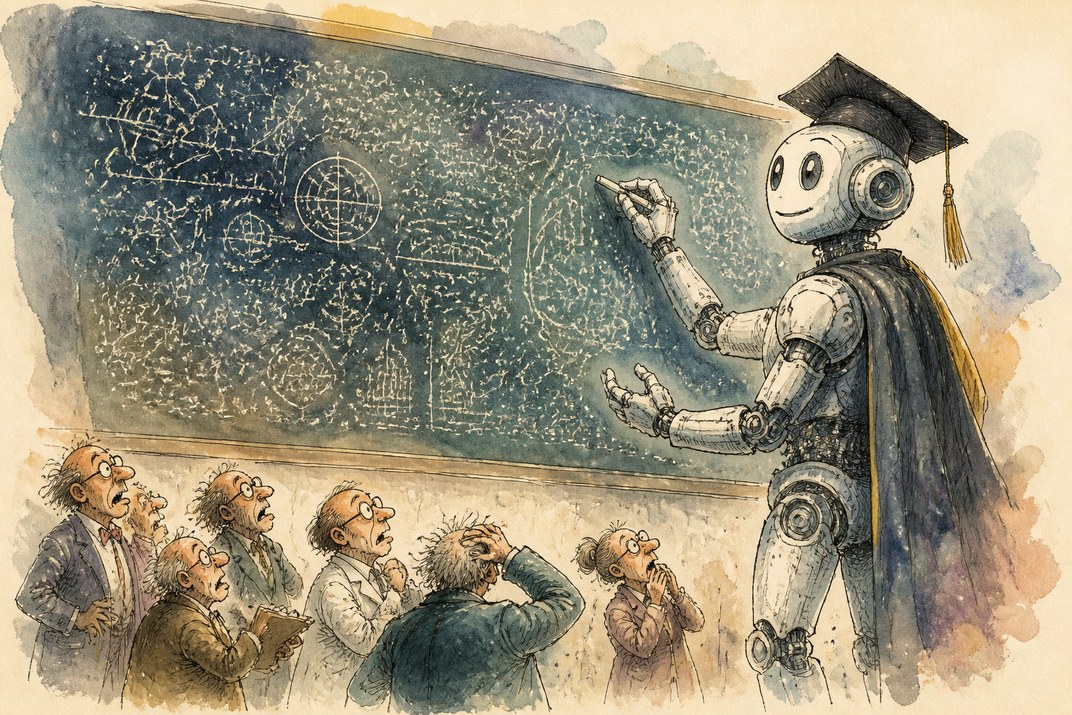
OpenAI's math breakthrough solves a Millennium Prize problem, unsettling academia
02
Anthropic researcher quits, warns self-improving AI could "kill us all"
03
Paul Christiano joins OpenAI Foundation Board and Safety Committee
04
How to deploy Qwen3's 2.4T-parameter model on SageMaker HyperPod with vLLM
05
Qwen 3.8 found mimicking GPT-5.5 Pro reasoning prefills
Main story
OpenAI's math breakthrough solves a Millennium Prize problem, unsettling academia
OpenAI announced it has solved one of mathematics' legendary Millennium Prize problems, a result that is both a genuine achievement and a sharp demonstration of how fast AI capabilities are advancing.
Why it matters: This is the clearest public evidence yet that frontier models are crossing into expert-level reasoning, which directly raises the stakes of the safety debate happening in parallel.
What to watch next: Watch whether other frontier labs respond to OpenAI's math result by accelerating their own formal safety commitments, or whether the capability demonstration widens the gap between what models can do and what oversight structures can handle.
Two parallel moves, one researcher quitting Anthropic with a public warning and a prominent alignment expert joining OpenAI's board, signal that the industry's safety debate is moving from internal memos to formal governance structures, and the stakes are being named out loud.
Size of the Qwen3 open-weight model now deployable on managed cloud infrastructure · AWS Machine Learning Blog
Watch · On the feeds
ChatGPT Work, now powered by GPT-6 Astra
OpenAI
A New Way to Build Edge AI: Agentic Development on NVIDIA Jetson
NVIDIA Developer
The Signal
Today's items collectively show a field under genuine tension: capabilities are advancing faster than governance can keep up, and the people closest to the work are saying so publicly. OpenAI solving a Millennium Prize problem and a 2.4-trillion-parameter open-weight model becoming deployable on managed cloud infrastructure are not isolated milestones. They are the context in which a senior Anthropic researcher quits with a public warning and a leading alignment researcher steps onto OpenAI's formal oversight board. For engineering and product leaders, the practical read is this: the gap between what models can do and what your organisation has policies for is widening, and the window to close it is shorter than most roadmaps assume.
All the best, the KYFEX team
“We really do earnestly believe AI could kill all humans!”
Ars Technica
Quick hits
AI safety reaches a governance inflection point
Anthropic researcher quits, warns self-improving AI could "kill us all"
Jacob Coxon left Anthropic and told WIRED that the lab is running a "mini Manhattan project" and that AI labs have only a few years to make their systems safe before the window closes.
Why it matters: When a safety researcher walks out and goes public, it is a signal worth taking seriously on your risk register, especially if your roadmap depends on frontier model capabilities.
Paul Christiano joins OpenAI Foundation Board and Safety Committee
Paul Christiano, one of the most influential voices in AI alignment research, is joining the OpenAI Foundation Board and its Safety and Security Committee.
Why it matters: Adding a credible alignment researcher to a formal oversight body is a governance move that may affect how OpenAI's safety commitments are evaluated by regulators and enterprise customers alike.
Frontier model deployment gets cheaper and more capable
A 2.4-trillion-parameter open-weight model landing on managed infrastructure, a new reasoning-prefill behavior spotted in Qwen 3.8, and a heavily discounted Google coding model all point in the same direction: the cost and complexity of running frontier-class models in production is falling fast.
How to deploy Qwen3's 2.4T-parameter model on SageMaker HyperPod with vLLM
AWS published a full walkthrough for running Qwen3.8-2.4T-A95B on SageMaker HyperPod, covering cluster setup, NVFP4 quantization to fit the model in memory, and an OpenAI-compatible endpoint.
Why it matters: NVFP4 quantization making a 2.4T-parameter model deployable on managed cloud infrastructure is a practical milestone: teams that ruled out models this large on cost or complexity grounds should revisit that assumption.
Qwen 3.8 found mimicking GPT-5.5 Pro reasoning prefills
A Hacker News thread surfaced evidence that Qwen 3.8 follows reasoning prefills from GPT-5.5 Pro, suggesting open-weight models are absorbing behavioral patterns from closed frontier models.
Why it matters: If open-weight models can be steered with prefills designed for closed models, that opens new fine-tuning and prompting shortcuts but also raises questions about unintended capability transfer.
This course will teach you about large language models using libraries from the HF ecosystem
Hugging Face · Free
Put it to work
Try this today
Audit your AI deployment for consent and data-handling gaps
You are a privacy and compliance advisor. Review the following description of an AI-powered product feature and identify: (1) every point where user data is captured, stored, or processed; (2) any gap between what users are likely to expect and what actually happens; (3) the three highest-priority consent or data-handling risks; and (4) one concrete remediation step for each risk. Be specific and practical. Feature description: [paste your feature description here]
Why it helps: With Apple's always-listening features landing in consumers' hands today, now is the right moment to run this audit on any ambient or always-on capability in your own pipeline before regulators ask first.
Before you ship it
The risk
Always-on ambient audio features, like those shipping in Apple Watch today, create a consent gap: users may not understand when recording is active, what is retained, or who can access it, and that gap becomes a liability the moment a regulator or plaintiff asks.
Do this
Audit every ambient or continuous-capture feature in your product against a plain-language consent checklist, confirm that data-minimisation controls are enforced at the hardware or OS level, and document that audit before the feature ships.
Ready to ship AI, not just read about it?
KYFEX designs and builds production AI for teams that need it working, not just demoed. Tell us what you're working on and we'll bring the engineering.