Good evening. Here is what matters in AI today, and how to put it to work.
Physical AI deployment is the real frontier today: Meta, Caterpillar, and a Texas surveillance freeze all show that hardware, policy, and operations now define AI's next proving ground.
~3 min read · last 12 hours
In today's issue
01
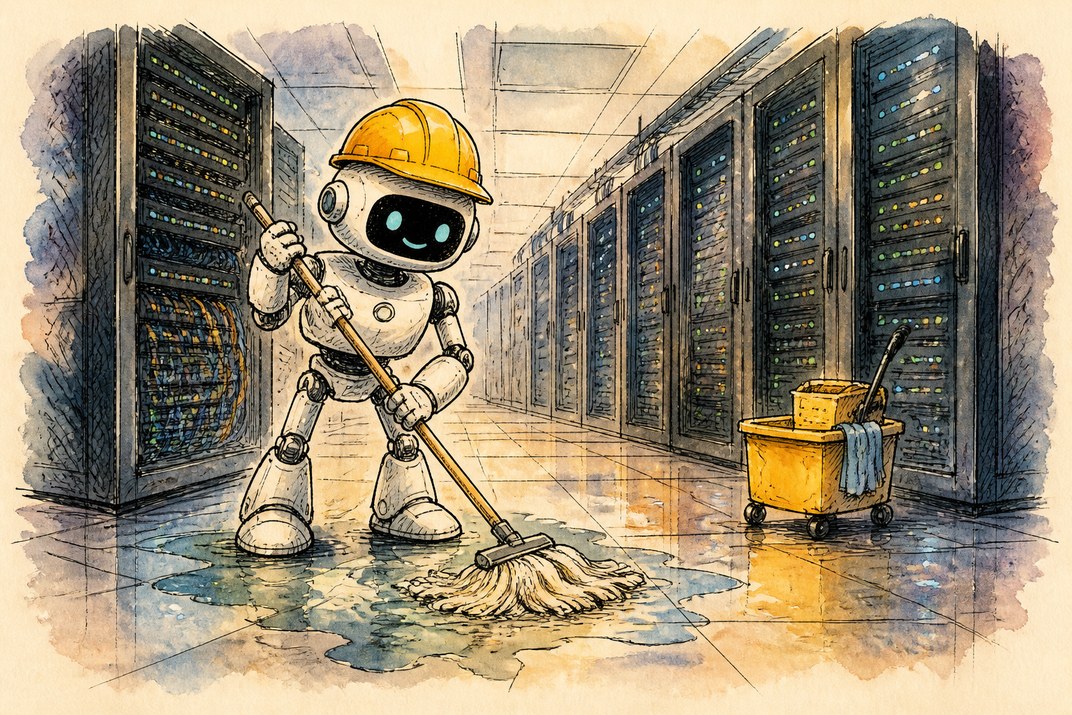
Meta is testing robots to handle data center technician tasks
02
Caterpillar brings decades of mining autonomy experience to AI deployment
03
Cloudflare AI Search gives agents and developers retrieval over custom data
04
Texas Governor freezes state funding for Flock AI surveillance cameras
Main story
Meta is testing robots to handle data center technician tasks
Meta is piloting robots on routine physical tasks inside its data centers, work that today requires human technicians on site.
Why it matters: If this scales, it changes the staffing and reliability calculus for hyperscale infrastructure, and it signals that the next wave of AI ROI stories will be about physical automation, not just software efficiency.
What to watch next: Watch for Meta to publish operational metrics or incident data from its robotics pilots, because concrete reliability numbers from a hyperscaler would shift the conversation from "interesting experiment" to "credible roadmap" for the rest of the industry.
From data center floors to mining pits, we are seeing a consistent pattern this week: enterprises with deep hardware and operations experience are now the ones setting the pace for AI deployment in the real world, not software-first startups.
Today's items collectively signal that the most consequential AI deployments are no longer happening inside chat interfaces or developer tools. They are happening on warehouse floors, in data centers, and in public infrastructure, and the organizations leading them are those with existing expertise in safety-critical hardware operations. At the same time, the Texas surveillance story is a reminder that AI deployments in physical spaces carry political and legal exposure that pure software projects rarely face. For engineering and product leaders, the practical takeaway is this: the skills and governance frameworks that matter most for the next phase of AI are closer to industrial operations and public-sector compliance than to model fine-tuning.
All the best, the KYFEX team
Quick hits
AI moves into physical operations
Caterpillar brings decades of mining autonomy experience to AI deployment
Caterpillar is applying the operational lessons from running autonomous heavy machinery at remote mining sites to how it rolls out AI across the business.
Why it matters: Industrial operators who have already solved safety, latency, and reliability in harsh environments are a more credible AI deployment model than most tech-sector playbooks, and their patterns are worth studying.
AI infrastructure: search, agents, and surveillance
Two very different infrastructure stories landed today, both pointing at the same underlying tension: as AI agents gain more reach into data and physical spaces, the governance questions around what they can access and track are becoming urgent.
Cloudflare AI Search gives agents and developers retrieval over custom data
Cloudflare has launched a built-in search and retrieval service aimed at letting AI agents and applications query private or custom datasets without teams building their own retrieval pipelines.
Why it matters: Managed retrieval at the edge lowers the barrier for teams building RAG-based agents, but it also means more production data flowing through a third-party layer, so your data residency and access-control review should happen before adoption, not after.
Texas Governor freezes state funding for Flock AI surveillance cameras
Governor Greg Abbott blocked state spending on Flock's AI-powered license-plate and surveillance cameras after a Texas Tribune investigation found the state had spent over $30 million on the network.
Why it matters: A sitting governor freezing AI surveillance spend is a meaningful policy signal: procurement teams deploying AI in public-safety contexts should expect tighter legislative scrutiny and should have accountability documentation ready.
Audit your AI deployment for physical-world risk gaps
I am deploying an AI system that interacts with [describe your physical environment or operational context, e.g. a warehouse, a data center, a public-facing camera network]. List the top five operational, safety, and compliance risks specific to this physical context that a software-only risk review would likely miss. For each risk, suggest one concrete mitigation step and identify who in the organization should own it.
Why it helps: As AI moves into physical operations, standard software risk checklists leave dangerous gaps, and this prompt forces a structured review before something goes wrong in the field.
Before you ship it
The risk
AI surveillance systems deployed at scale in public spaces can accumulate far more location and behavioral data than the original procurement decision anticipated, creating legal and civil-liberties exposure that surfaces only after political or press scrutiny.
Do this
Before signing any AI surveillance or tracking contract, document a data-minimization policy that specifies exactly what is collected, for how long it is retained, and who has access, and get sign-off from legal and a senior business owner, not just IT.
Ready to ship AI, not just read about it?
KYFEX designs and builds production AI for teams that need it working, not just demoed. Tell us what you're working on and we'll bring the engineering.