Good evening. Here is what matters in AI today, and how to put it to work.
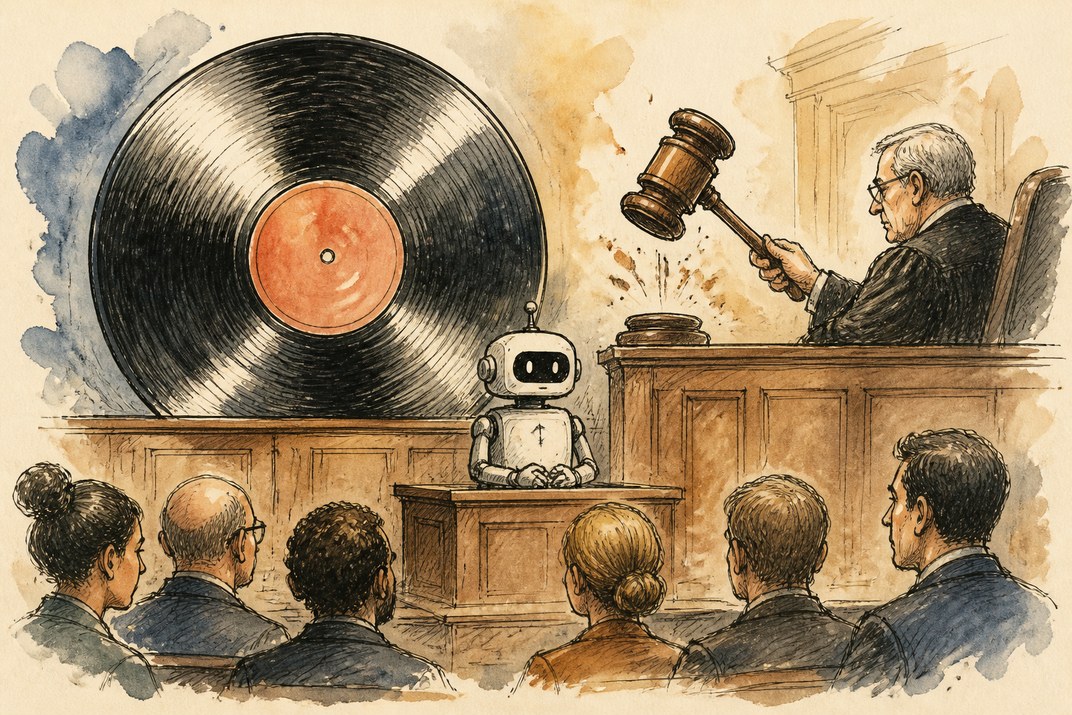
We see AI's music copyright reckoning arrive in force today, with major labels suing Anthropic for up to $150,000 per work across tens of thousands of songs.
~3 min read · last 12 hours
In today's issue
01
Sony Music and Warner Chappell sue Anthropic over "tens of thousands" of copyrighted works
02
Sony and Warner's Anthropic suit targets what lawyers are calling a "brazen campaign" of IP theft
03
Musicians are building grassroots networks to detect and report AI-generated music fraud
04
Nvidia's AI edge is expanding from GPUs into smarter data-center networking and traffic control
05
vLLM v0.28.0 ships with new inference efficiency improvements
Main story
Sony Music and Warner Chappell sue Anthropic over "tens of thousands" of copyrighted works
The labels filed suit in the Northern District of California seeking up to $150,000 per work in damages, making this one of the broadest copyright actions yet brought against an AI company.
Why it matters: A damages exposure at that scale, applied across tens of thousands of works, could reshape how every AI lab licenses training data going forward, so legal and procurement teams should be reviewing training-data provenance now.
What to watch next: Watch for other major rights holders, particularly in publishing and film, to file similar suits in the coming weeks if this complaint survives early motions to dismiss.
We are watching a coordinated legal and grassroots push against AI's use of copyrighted music converge at the same moment, which signals that the informal era of training on unlicensed content is closing fast.
Maximum statutory damages per work sought by Sony and Warner against Anthropic · The Verge
Watch · On the feeds
Tennis (:30)
OpenAI
The Signal
The Sony and Warner suits against Anthropic are not just another IP skirmish. They target training-time ingestion as the act of infringement, not just model outputs, which is a legal theory that, if it holds, would force every AI lab to audit and relicense its training corpora. Paired with musicians independently organizing to hunt down AI-generated clones, we are seeing the informal licensing free-for-all that powered the first wave of generative AI close from two directions at once. On the infrastructure side, Nvidia's move beyond the GPU and a new vLLM release are quiet reminders that the cost and efficiency curve is still moving, and that competitive advantage is shifting toward systems-level thinking, not raw compute procurement.
All the best, the KYFEX team
Quick hits
AI and music copyright reach a legal inflection point
Sony and Warner's Anthropic suit targets what lawyers are calling a "brazen campaign" of IP theft
The complaint goes beyond output reproduction, focusing on the alleged systematic piracy of lyrics and other protected text during model training.
Why it matters: Framing training-time ingestion as piracy, not fair use, is a harder legal theory to defend against and could set precedent that affects the entire industry.
Musicians are building grassroots networks to detect and report AI-generated music fraud
As generative audio tools grow more capable, artists are acting as informal detectives, identifying AI-cloned vocals and melodies on streaming platforms and flagging them for takedown.
Why it matters: This community-driven enforcement layer is filling a gap that platforms and regulators have not yet closed, and it points to reputational and legal risk for any product built on unlicensed audio generation.
Infrastructure and investment bets shaping AI's next layer
While the copyright fight dominates headlines, quieter but consequential moves in inference infrastructure and biotech capital allocation are defining where durable AI value will actually be built.
Nvidia's AI edge is expanding from GPUs into smarter data-center networking and traffic control
The new generation of Nvidia data-center systems improves efficiency by optimizing how data moves between processors, not just by adding more compute.
Why it matters: Teams planning infrastructure spend should factor in networking and systems-level efficiency as a first-class cost lever, not an afterthought to raw GPU count.
vLLM v0.28.0 ships with new inference efficiency improvements
The popular open-source LLM serving framework released version 0.28.0, continuing its rapid iteration on throughput and latency for production deployments.
Why it matters: Teams running self-hosted inference should evaluate this release promptly: incremental vLLM updates have consistently translated into meaningful cost-per-token reductions in production.
This course will teach you to build robots with using LeRobot
Hugging Face · Free
Put it to work
Try this today
Audit your product's training-data provenance for copyright risk
I am reviewing the training data sources used in our AI product for potential copyright exposure. Here is a description of our data pipeline and sources: [paste your description]. Please help me identify: 1) which source categories carry the highest legal risk based on recent copyright litigation trends, 2) what questions I should be asking our data and legal teams, and 3) what licensing or documentation steps would reduce our exposure. Focus on practical next steps, not general disclaimers.
Why it helps: With major labels now suing over training-time ingestion, a structured internal audit framed around current litigation theory is the right first move for any team that has not already done one.
Before you ship it
The risk
Using commercially released music, lyrics, or audio recordings as training or fine-tuning data without explicit licensing exposes your organization to the same statutory-damages theory now being tested against Anthropic, where per-work penalties can compound into existential liability.
Do this
Document every data source in your training pipeline with its license status before your next model update, and route any unlicensed commercial content through legal review before it enters a training set.
Ready to ship AI, not just read about it?
KYFEX designs and builds production AI for teams that need it working, not just demoed. Tell us what you're working on and we'll bring the engineering.