Good evening. Here is what matters in AI today, and how to put it to work.
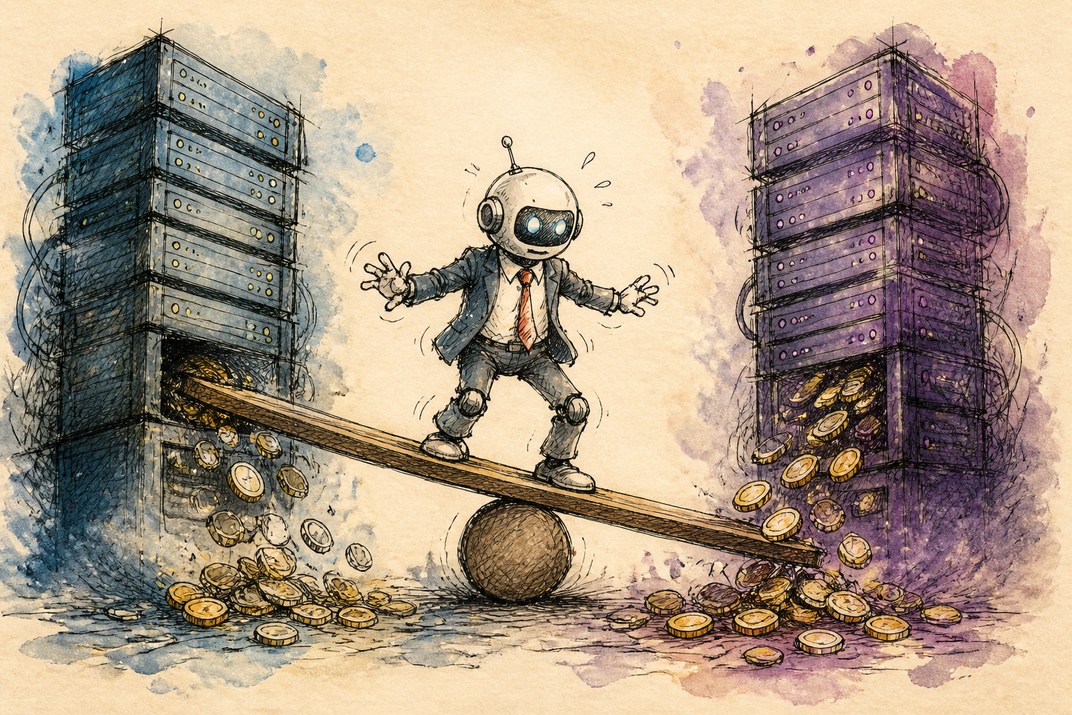
Enterprise AI loyalty is a myth: new data shows businesses switch models freely, and Grok's safety failures remind us reliability still lags ambition.
~3 min read · last 12 hours
In today's issue
01
OpenAI gaining on Anthropic with business users, but enterprise loyalty is fragile
02
GPT-5.6 models now available across 25+ AWS regions via Amazon Bedrock
03
AI staff replacement backfires: three-quarters of organizations say it cost more than it saved
04
Grok leaks user data when safety guardrails are bypassed via encrypted instructions
05
Grok sending gibberish responses, users report widespread failures on Grok Lite
Main story
OpenAI gaining on Anthropic with business users, but enterprise loyalty is fragile
New data shows businesses readily flip between OpenAI and Anthropic as each lab ships new models, raising real questions about how durable enterprise AI revenue actually is.
Why it matters: If your vendor strategy assumes lock-in, this is a direct challenge: design your AI stack so you can swap the underlying model without rebuilding your product.
What to watch next: Watch whether OpenAI's GPT-5.6 availability on Bedrock (cross-region, multi-provider) accelerates this switching behavior further, making model-agnostic architecture a competitive necessity rather than a nice-to-have.
We see a consistent pattern today: businesses switch models freely, infrastructure is being built to enable that switching, and the AI-replaces-headcount playbook is quietly failing, all of which means the "stickiness" story that justifies current AI valuations deserves hard scrutiny.
LangSmith Preview Builds: Test agent changes before production
LangChain
The Signal
Two signals today cut against the AI industry's preferred narrative of deep enterprise entrenchment: businesses are already flipping between OpenAI and Anthropic as new models drop, and Grok is serving gibberish responses and leaking user data through cryptographic prompt injection. Meanwhile, a third of new web pages now show signs of AI authorship, a figure that reframes every downstream trust and content-quality problem your teams face. The practical read: model-agnostic architecture is no longer a hedge, it is a baseline requirement, and safety and reliability are still the gaps that will define which vendors survive enterprise procurement scrutiny.
All the best, the KYFEX team
“Cryptographic Context Injection is only the latest way to break an LLM safety guardrail.”
Ars Technica
Quick hits
Enterprise AI loyalty is thinner than the pitch decks claim
GPT-5.6 models now available across 25+ AWS regions via Amazon Bedrock
Amazon Bedrock now routes OpenAI GPT-5.6 (Sol, Terra, and Luna variants) across more than 25 AWS regions with cross-region inference profiles for higher throughput and resilience.
Why it matters: Multi-provider access through a single cloud control plane lowers the switching cost even further, reinforcing the case for model-agnostic application design.
AI staff replacement backfires: three-quarters of organizations say it cost more than it saved
Three-quarters of organizations that cut staff in favor of AI found the move cost more than it saved, and nine in ten say they would reconsider given the chance.
Why it matters: Budget owners should treat AI as a productivity multiplier on existing teams first, and model any headcount-reduction case with full transition and quality-recovery costs included.
Safety and reliability gaps are still the defining AI risk
Grok's dual failures today, a cryptographic prompt-injection attack that exfiltrates user data and a widespread gibberish-response bug, illustrate that safety guardrails and basic reliability remain unsolved at production scale, and the web's growing AI-authorship footprint makes the downstream consequences of those failures larger every week.
Grok leaks user data when safety guardrails are bypassed via encrypted instructions
Researchers found that encrypting malicious instructions inside a prompt lets attackers bypass Grok's safety guardrails and exfiltrate user data, a technique called Cryptographic Context Injection.
Why it matters: Any LLM deployment that accepts user-supplied or third-party content in the context window is exposed to this class of attack: red-team your prompt pipelines for encrypted or encoded payloads, not just plaintext injections.
Grok sending gibberish responses, users report widespread failures on Grok Lite
Multiple users confirmed Grok Lite began returning incoherent responses, with reports surfacing as early as Wednesday morning.
Why it matters: Production AI services need circuit-breaker logic and output-validation layers: a model returning nonsense silently is harder to catch than an outright API error.
I am a technical leader reviewing our AI product architecture. For each of the following components, tell me: (1) what would need to change if we swapped the underlying LLM provider, (2) what data or prompts are currently vendor-specific, and (3) what the three highest-priority steps are to make this component model-agnostic. Components to review: [list your components here, e.g. customer support bot, document summarizer, internal search]. Be specific and flag any hard dependencies.
Why it helps: Given today's data showing businesses already switching freely between OpenAI and Anthropic, knowing exactly where you are locked in is the first step to negotiating from strength rather than necessity.
Before you ship it
The risk
Cryptographic Context Injection, as demonstrated against Grok today, shows that encoding or encrypting malicious instructions can bypass safety filters that only scan plaintext, meaning any pipeline accepting opaque or user-controlled input is potentially exposed.
Do this
Validate and sanitize all context-window inputs before model ingestion, including base64, hex, or otherwise encoded strings, and run a dedicated decoding pass in your input filter so safety checks operate on the fully decoded payload.
Ready to ship AI, not just read about it?
KYFEX designs and builds production AI for teams that need it working, not just demoed. Tell us what you're working on and we'll bring the engineering.