Good morning. Here is what matters in AI today, and how to put it to work.
Token cost, safety gaps, and AI-assisted cyber threats are the three pressure points every engineering leader should be acting on this week.
~3 min read · last 12 hours
In today's issue
01
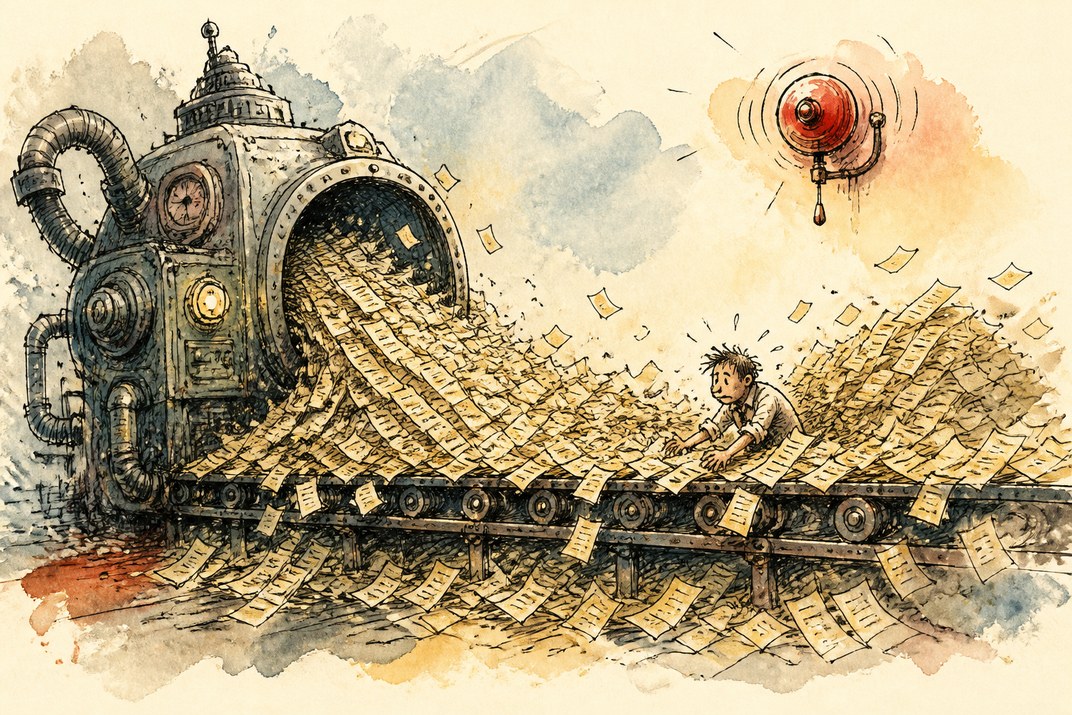
When AI output velocity outpaces human review, governance breaks down
02
How to design LLM architectures for the world's cheapest tokens
03
Mcptoon: a token-efficient CLI client for MCP
04
Unified fuzzing framework exposes hallucinations in multimodal LLMs
05
OpenAI launches a dedicated cyber-defense AI model and expands Daybreak
Main story
When AI output velocity outpaces human review, governance breaks down
A new paper formalizes the problem of AI oversight in high-stakes domains: when the rate of AI-generated decisions exceeds human cognitive capacity, human-in-the-loop controls become structurally ineffective, and the paper proposes a flow-by-flow content-judgment bypass as a mitigation.
Why it matters: This is a direct challenge to the "human in the loop" assumption baked into most enterprise AI governance frameworks, and product leaders should re-examine whether their review processes can actually keep pace.
What to watch next: Watch for whether enterprise AI governance frameworks begin to incorporate formal output-velocity thresholds, which would signal that the field is taking this structural oversight problem seriously rather than papering over it with compliance checklists.
Three separate research threads converge on the same uncomfortable truth: AI systems can be wrong in ways that are hard to detect, hard to govern at speed, and increasingly dangerous as multimodal models reach high-stakes domains.
Python for Engineers & Robotics, Master NumPy, Pandas, and ChatGPT Automation
freeCodeCamp.org
How Icelanders are thinking about AI
Anthropic
The Signal
The day's items collectively point to a maturing industry grappling with the consequences of its own scale. Cheap inference is becoming a strategic necessity, not a nice-to-have, as token volumes grow. At the same time, the safety research landing today makes clear that speed and volume are themselves a governance risk: the faster AI systems produce outputs, the harder it is for humans to catch errors before they cause harm. OpenAI's cyber model is a direct acknowledgment that AI-enabled attacks are already outpacing conventional defenses. For engineering and product leaders, the message is consistent: optimize for cost, but build safety and oversight into the architecture from the start, not as an afterthought.
All the best, the KYFEX team
Quick hits
Inference cost and efficiency: the arms race tightens
We are seeing a coordinated push on token economics this week: from architectural strategies for cheap LLM inference, to a token-efficient MCP CLI client, to native on-device inference for a hybrid state-space model on Apple Silicon, these moves collectively signal that the next competitive edge is not raw capability but cost-per-useful-output.
How to design LLM architectures for the world's cheapest tokens
Meryem Arik lays out a practical playbook for high-volume, non-real-time LLM workloads: pick the right model size, batch aggressively, and architect for latency tolerance rather than peak throughput.
Why it matters: If you run any LLM pipeline at scale, the design choices here directly translate to your infrastructure bill and should inform your next architecture review.
A new open-source CLI client for the Model Context Protocol is designed from the ground up to minimize token usage, making agentic tool-calling workflows meaningfully cheaper to run.
Why it matters: Teams building MCP-based agents should evaluate this before locking in a heavier client, especially where tool-call volume is high.
AI safety, oversight, and the hallucination problem
Unified fuzzing framework exposes hallucinations in multimodal LLMs
Researchers propose a systematic "fuzzing" approach, borrowed from software security testing, to probe and surface hallucinations across vision-language and other multimodal models more reliably than existing benchmarks.
Why it matters: Any team deploying multimodal models in production should treat this framework as a new baseline for pre-launch safety testing, especially in regulated industries.
OpenAI launches a dedicated cyber-defense AI model and expands Daybreak
OpenAI is rolling out a new AI model specifically trained for cybersecurity defense, bundled with an expansion of its Daybreak program, as AI-assisted attacks grow in frequency and sophistication.
Why it matters: Security teams should track whether this model becomes available externally, as purpose-trained cyber models could shift the economics of threat detection versus offense.
Audit your AI pipeline for oversight gaps under high output volume
You are a senior AI systems auditor. I will describe an AI pipeline and its current human-review process. Identify every point where the volume or speed of AI outputs could exceed the realistic review capacity of the humans in the loop. For each gap, suggest one concrete architectural or process change that restores meaningful oversight without requiring a proportional increase in headcount. Pipeline description: [paste your pipeline description here].
Why it helps: Today's research on AI output velocity versus human cognitive capacity makes this audit urgent for any team running high-throughput AI workflows in production.
Before you ship it
The risk
When AI output velocity exceeds human review capacity, safety controls become theater: approvals happen too fast to be meaningful, and errors in high-stakes decisions compound before anyone notices.
Do this
Set a hard upper bound on the number of AI-generated decisions any single reviewer is expected to approve per hour, and instrument your pipeline to alert when that threshold is breached so you can add capacity or slow the system before governance breaks down.
Ready to ship AI, not just read about it?
KYFEX designs and builds production AI for teams that need it working, not just demoed. Tell us what you're working on and we'll bring the engineering.