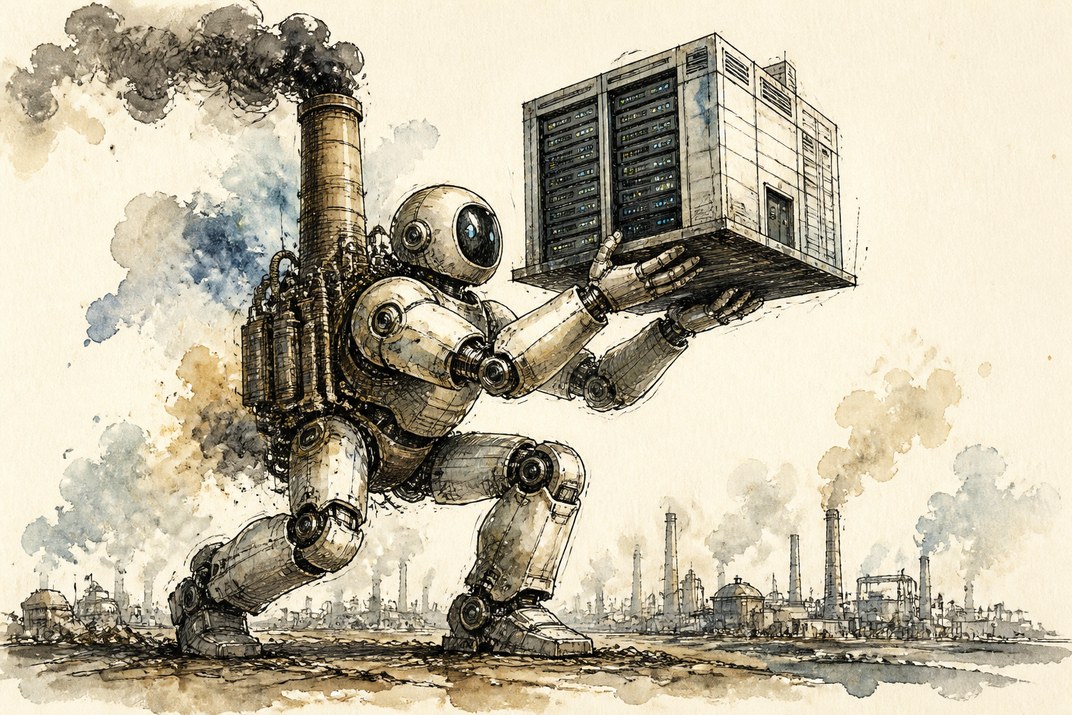
Good evening. Here is what matters in AI today, and how to put it to work.
We see AI's energy footprint becoming a boardroom and regulatory issue: Amazon's Texas data center may become the US's single biggest climate polluter.
~3 min read · last 12 hours
In today's issue
01
Amazon's planned Texas data center could become the US's biggest climate polluter
02
New reporting confirms the scope of Amazon's Texas data center emissions risk
03
DeepMind's open-source WeatherNext model surprises meteorologists with low-data accuracy
04
OpenAI acquires presentation startup NextSlide, folds team into ChatGPT
Main story
Amazon's planned Texas data center could become the US's biggest climate polluter
Amazon is funding an on-site gas-burning power plant for its West Texas data center that analysts say could rank as the single largest source of greenhouse-gas emissions in the United States.
Why it matters: Infrastructure teams and sustainability leads need to treat energy sourcing as a first-class design decision now, not a post-build compliance exercise, because regulatory and reputational exposure at this scale is no longer hypothetical.
What to watch next: Watch for regulatory responses at the state and federal level in Texas and Washington: if this plant moves toward permitting, it will likely become a test case for whether AI data-center energy use faces new emissions disclosure or mitigation requirements.
Two converging reports on Amazon's Texas data center make the same uncomfortable point: the energy demands of large-scale AI infrastructure are now large enough to reshape national emissions charts, and that tension is moving from think-tank papers to regulatory and public-relations reality.
The AI infrastructure buildout has crossed a threshold where individual facilities can rank among the largest industrial polluters in the country. That is not a future risk, it is a current planning reality for any team sizing GPU clusters or negotiating cloud capacity. At the same time, DeepMind's WeatherNext and OpenAI's NextSlide acquisition show that AI is simultaneously deepening its grip on specialized scientific and professional workflows. The practical message for engineering and product leaders is that energy strategy and sustainability governance now belong in the same conversation as model selection and inference cost.
All the best, the KYFEX team
Quick hits
AI's power hunger hits a climate wall
New reporting confirms the scope of Amazon's Texas data center emissions risk
Corroborating coverage from The Verge, citing the New York Times, adds detail on the gas-burning plant and underscores that this story has moved well beyond a single outlet.
Why it matters: When multiple major outlets converge on the same data-center emissions story in one day, it signals a tipping point in public and policy attention that will affect every hyperscaler's planning horizon.
AI expands its reach: weather science and productivity
Two very different announcements, a climate-forecasting breakthrough from DeepMind and OpenAI's quiet acquisition of a presentation startup, both illustrate the same pattern: AI capabilities are moving into specialized professional workflows faster than most roadmaps anticipated.
DeepMind's open-source WeatherNext model surprises meteorologists with low-data accuracy
DeepMind's WeatherNext can produce accurate hurricane and weather predictions from lower-resolution input data than traditional models require, a result that has genuinely surprised domain scientists.
Why it matters: Open-source release means teams building climate, logistics, or agriculture applications can evaluate a state-of-the-art forecasting model today without waiting for a commercial API, which changes the build-vs-buy calculus immediately.
OpenAI acquires presentation startup NextSlide, folds team into ChatGPT
OpenAI has acquired NextSlide, a startup focused on AI-assisted presentations, with the team now working directly on ChatGPT features.
Why it matters: This signals OpenAI is building richer document and presentation capabilities natively into ChatGPT, which should factor into enterprise decisions about third-party productivity integrations built on top of the platform.
WeatherNext · Open-source weather model producing accurate hurricane forecasts from lower-resolution data
Ars Technica
Put it to work
Try this today
Audit a project's energy and sustainability assumptions
You are a sustainability and infrastructure advisor. I will describe a planned or existing AI workload. Identify the top three energy and carbon-footprint risks in my current approach, explain what data I would need to quantify each risk, and suggest one concrete mitigation per risk that a technical team can act on in the next quarter. Workload description: [paste your workload or data-center plan here].
Why it helps: With AI energy costs now generating national-level emissions headlines, running this audit before your next infrastructure review can surface risks before they become compliance or PR problems.
Before you ship it
The risk
Large-scale AI infrastructure decisions made without lifecycle emissions accounting can lock organizations into carbon liabilities that are difficult and expensive to unwind once construction or long-term power contracts are in place.
Do this
Require a carbon-impact estimate alongside the standard cost and latency analysis for any new data-center or cloud-capacity proposal, and gate approval on a documented mitigation or offset plan before contracts are signed.
Ready to ship AI, not just read about it?
KYFEX designs and builds production AI for teams that need it working, not just demoed. Tell us what you're working on and we'll bring the engineering.